
To my fellow attendees at the conference this September! Oh my, have we got a treat in store!
I have just spent four nights at Dartington Hall. I am considering a move to nearby Totnes later in the year and wanted to check out the locale. The Hall seemed to be the place to stay. Not simply for its reasonable rates. Mainly because…well, need I even say it? You will all understand already because, like me, like any writer of historical fiction, you are obsessed by history. So, to visit somewhere where so much happened – from the medieval times of hunts, jousts, and liaisons through the extraordinary experiments in utopian idealism of the 20th century – Dartington Hall affords the chance to simply ‘be’ and feel the vibes of other peoples, in other times.

On occasions in my life I have been blessed to have had certain locations with remarkable histories entirely to myself. Where I was able to wander solo and be inspired by the stones or the wood around me. Places which I firmly believe retain both the energies of their creation… and the energies expended within their bounds. One Peruvian dawn in 1988, in the Urubamba Valley I climbed alone up to the temple of Pisac and saw the Inca dance. One afternoon I sat in the old dining hall of the Princely Court in Targoviste, Romania – a place of murder and other fell deeds – conjuring the real Dracula. Then there were the days spent at Scotland’s Hawthornden Castle, above the Pictish caves. I was on a month’s retreat and meant to be feverishly writing my third novel. Instead I mostly found myself in a bay window in the oak-panelled library within the ruined medieval tower, watching fox cubs gambol in the woods, and reading Robert Louis Stevenson.
To these moments and others I can now add the explorations of Dartington Hall. I know I don’t need to tell historical fiction writers too much – each of you will be doing your own research before you arrive here – but briefly…
The land was gifted to John Holand, by his half-brother King Richard 11, around 1388 AD, and it was John who arranged the building of the Great Hall as well as the high-vaulted kitchen with its giant chimneys where the feasts for the Hall were prepared. This is now The White Hart Pub – where, I suspect, we may be having a drink or two this September!
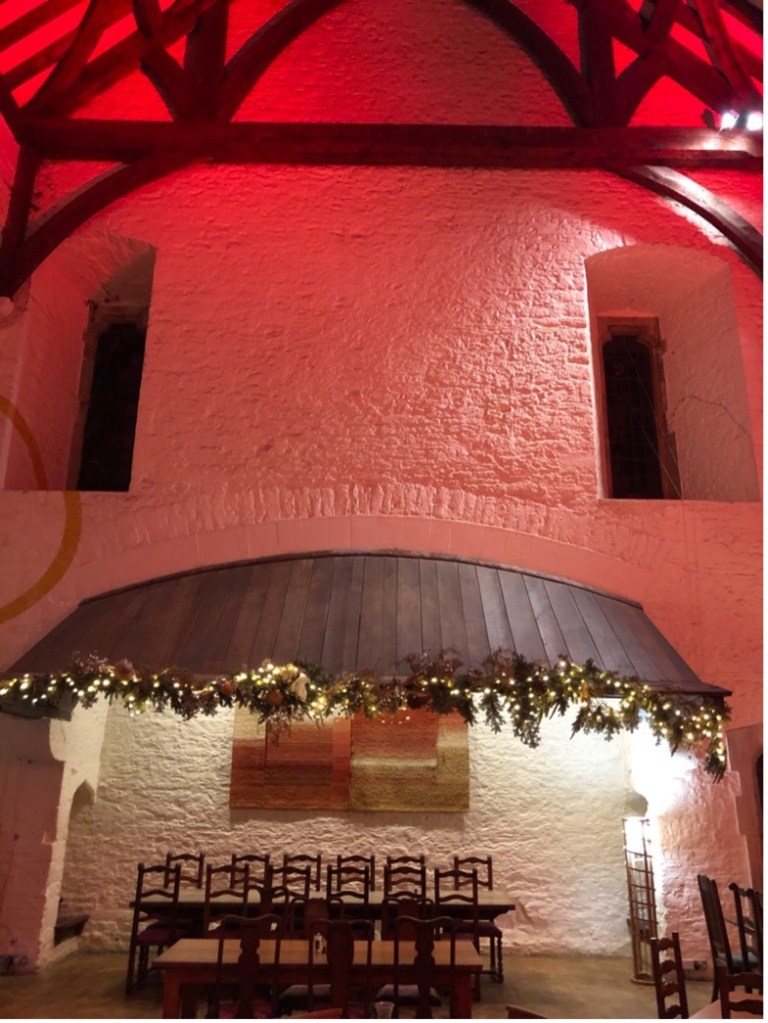
Above them there are two solars – large rooms – where, in more recent history, Paul Robeson once scandalously rehearsed Othello with his Desdemona, his secret lover, Peggy Ashcroft. The Barn, now a restaurant and cinema, was in the 1930’s the place where the Russian exile, Michael Chekov (Anton’s nephew) had his company, given shelter from Stalin to create and perform in freedom. (And write the acting textbook, To the Actor, which inspired the young acting Humphreys more than any other!)
So much history, distant and more recent. The Elmhirsts, Dorothy and Leonard, highly educated and cultured philanthropists, took over the ruined hall and estate in the 1920s to implement, encourage and blend ideas both ancient and modern, bringing together the farmer and the forester, the weaver and the woodworker, the artist and the artisan, drawing the best talents in those fields and many more from all over the world.
The extraordinary gardens are their living legacy.
There’s a yew in a graveyard that is between 1,500 and 2,000 years old. Yews were (are) the pre-Christian gateways to the underworld. So there’s a sense as you stand before it of a threshold between worlds, there in the vast trunk that twists like a basket of snakes. More practically, it would have been coppiced to create, among other things, shafts for English longbows. (Having, among too-many novel ideas, one about an English archer, I immediately whipped out my Moleskine and jotted down some thoughts!).

There’s the tiltyard, a nod to the first Lord of the Manor, John Holand, and his passion for jousting. Over the years, its sward and terraces have hosted marvellous dance and drama. It is overlooked by a mighty 300-year-old oak, the Luscombe Oak on one side, while a terrace of chestnut trees – 400 years old, lead down to a fabulous Henry Moore sculpture.

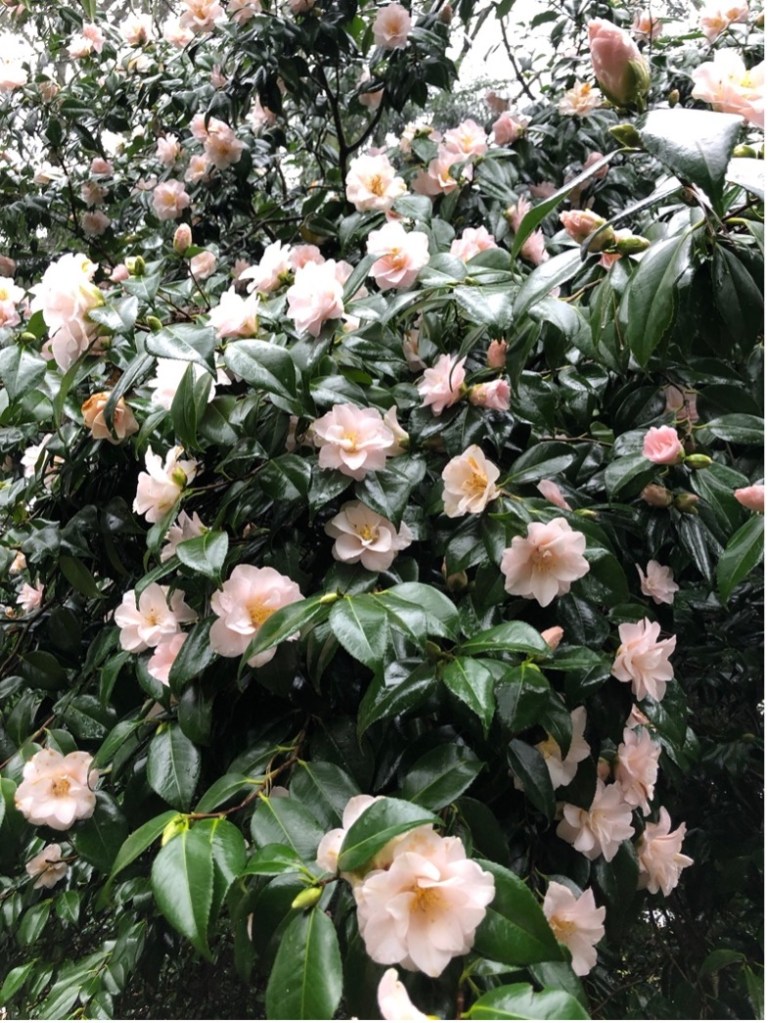
As you wander the paths between trees, lawns, and flowerbeds you come upon statues, a temple, dazzling arrays of every kind of tree, shrub, and flower imaginable, all designed and harmoniously arranged to enhance your every sense. There are sweet scents, explosions of colour, snowdrops, and crocuses everywhere, the first daffodils bursting forth, outrageous exuberances of camelias. And that’s in February! Imagine what awaits us all in September?
Bewitched from our wanders, we’ll return to the Hall, for a cup of tea or a pint in the White Hart. To the buzzy conversations stimulated by these surroundings. By the history, of course, given who we are, why we are there.
Yet there’s something else too. Something to consider. That when we are here, we can pause for a moment – this moment, now – and do what that great Indian poet and philosopher, Rabindranath Tagore – a guiding inspiration for this place – advises in a stone tablet in the gatehouse’s arch. (And recited by me below). Marvel at the history, for how can you fail to? Share our passions for this subject we love, historical fiction? Of course. Yet live in this fortunate ‘now’.
See you all in September!
Chris (C.C.) Humphreys is an award-winning novelist, playwright, actor and teacher, Chris Humphreys has written 22 novels including The French Executioner – runner up for the Steel Dagger for Thrillers, UK -The Jack Absolute trilogy, Vlad–The Last Confession, and A Place Called Armageddon. Chris adapted his 12th novel, Shakespeare’s Rebel for the stage and it received its premiere in 2015 at Bard on the Beach, Vancouver, Canada. His novel Plague won Canada’s Arthur Ellis Award for Best Crime Novel in 2015. Chasing the Wind follows the daring adventures of 1930s aviatrix, Roxy Loewen. His novels for young adult readers include, The Runestone Saga trilogy published by Knopf, as well as The Tapestry trilogy. His latest novel is Someday I’ll Find You, a WW2 epic romance, published by Doubleday. His novels have been translated into thirteen languages. He holds a Masters in Fine Arts (Creative Writing) from the University of British Columbia, has been keynote speaker and guest of honour at several conferences – including the HNS North American Conference in Denver, 2015. A busy audiobook narrator, as an actor, Chris has performed on stages from London’s West End to Hollywood.
Chris Humphreys is presenting a session with Diana Gabaldon on Sunday 8 September at the HNS UK 2024 conference.


 The Historical Novel Society UK 2024 conference
Leave a comment