Rebekah Simmers has been interviewing writers who will be presenting at the HNS 2024 UK Conference.

RS: We are so thrilled that you will be joining us for the HNS 2024 UK conference! What are you looking forward to about the conference? Can you share a teaser for your presentation?
KQ: I’ve been a longtime devotee of the US-based HNS conference—it’s such a great place for historical fiction folks to gather as a tribe, and I can’t wait to meet the tribe across the water (including many UK-based writers with whom I’ve been longtime friends online, but never met in person!). I’m doing two presentations: an ancient world panel with Ruth Downie and Alison Morton, both wonderful friends and co-collaborators, and an in-conversation chat at one of the midday luncheons. The rest of the time, I expect I’ll be wandering around star-struck and soaking it all in.

Kate Quinn is “In Conversation with Katherine Mezzacappa” for her Keynote speech.
Kate Quinn is also presenting with Alison Morton and Ruth Downie as part of the “Taking the Romans Public” Panel.
HNS has launched the First Chapters Competition with the conference and you’ve been so generous being one of our Final Round judges! What is a novel you’ve read over your life that unexpectedly grabbed you from the opening lines and whose words stayed with you? Do you have any tips for how you write / choose your own?
When I was growing up, I read a lot of Dick Francis mysteries and his opening pages were always absolute bangers. No one could get a story off the ground quickly and grippingly like DF. I think there’s a lot to learn, as historical fiction authors, from genre writers—we can get a bit too wrapped up in the world we’re building and the research we’ve done to furnish that world, and forget about getting the story going. When writing my own first scenes, I’ve certainly considered the immediacy of lines like “I was never particularly keen on my job before the day I got shot and nearly lost it, along with my life” from ODDS AGAINST, or “I intensely disliked my father’s fifth wife, but not to the point of murder” from HOT MONEY.
From following you on SM, you frequently share your writing journey, as well as talk about other writing friends and showcase their novels and champion their efforts. Writing can feel like such a solitary endeavor sometimes. How did you cultivate your writing circle over the years? What do you think makes writing groups successful? Unexpected benefits?
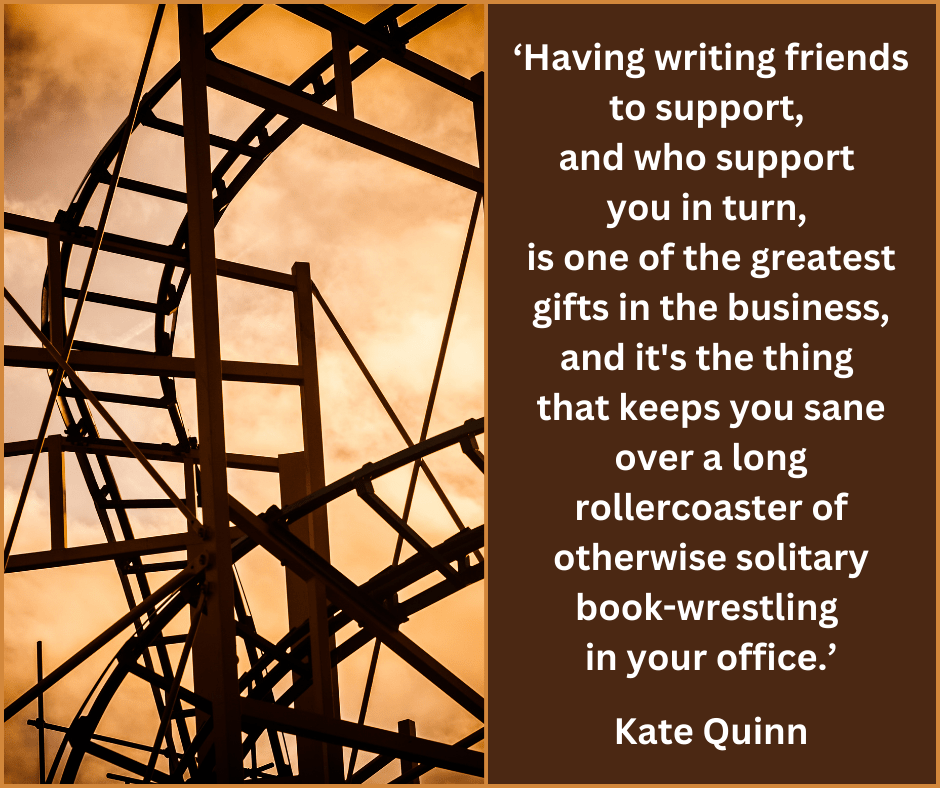
Writing is such a solitary business. I think it makes the importance of forming a community even more critical. Everywhere I’ve gone (and I move a lot because of a husband in the military) I’ve reached out to as many authors in the area as I can find to start in-person meetups, and I’m part of several online author groups as well, to keep touch with the folks who live further away. It’s important to have people in your life who understand this weird and wacky world we live in, people who will commiserate about copyedits and rage about idiotic online reviews and tell you “No, you have not forgotten how to write a novel, I promise” when you hit the inevitable mid-book slog on your current rough draft. Having writing friends to support, and who support you in turn, is one of the greatest gifts in the business, and it’s the thing that keeps you sane over a long rollercoaster of otherwise solitary book-wrestling in your office.
Looking back on your own writing career, what would you say was the most influential writing advice you received from another author? How have you made that work for you?
It’s been credited to everyone from Nora Roberts to Jodi Picoult, but the phrase “You can fix a bad page, but you can’t fix a blank page” is some of the best advice out there. Fundamentally you cannot get anywhere if you don’t finish the story.
What do you think it takes to have longevity across a writing career? Sanity? Fun? What’s an unexpected joy that came into your life from such a successful career?
I think the most important quality to a marathon writing career is realizing that it is a marathon, and not a sprint. And it’s also a roller-coaster: there are going to be ups and downs, and you have to have the flexibility to ride those out and realize when you might need to change a modus operandi that is no longer working for you.


You’ve released books back to back, you do appearances, you’re in the middle of a cross country move, you’re a judge for the competition, and you’re presenting at the conference – how do you balance it all, especially with the crazy life of being a military spouse? (Not gonna lie, you’re my mil spouse writing hero!) Do you have tricks you could share for managing your time and keeping up momentum? How has such a life impacted your writing?
Having no kids and no hobbies other than writing and reading helps! 😄 Mainly I juggle it all by realizing it all comes in cycles: when I launch a book and am doing lots of events, I accept that there will be very little time to write or draft whatever book I’m working on, and very little time to contribute to the house and family (my husband has zero problem carrying things when I’m gone). When the lull between book releases hits, that’s the time to really dive deep on research and drafting. When life and military stuff hits, like a cross-country move to a new posting, then everything writing-related from promo to events to drafting has to take a back seat. I try to map out my year month by month and see where the busy points hit: for this year I knew that two book launches and then the move would eat most of my spring and summer, so I pushed my next book deadline until the following year; the fall looked much more open so I scheduled that time for editing my WIP. I don’t think there’s any real way of doing it all at once, there’s just prioritizing different things at different points in the writing cycle as best you can.
As a historical writer, if you could stand witness to a historical event or walk through a specific time / scene / building or have a frank discussion with one historical figure, which would you choose and why?
I would want to visit the court of Elizabeth I because she was my absolute hero growing up—still is! Attend a Shakespeare play, eavesdrop on a council meeting, and hear her give the “Heart and stomach of a king” speech.
What can you share about what you are writing now? Or an upcoming release?
My next book, probably releasing in 2026, is a little bit of a departure for me—less straight historical fiction, a bit more magic realism. It’s titled THE ASTRAL LIBRARY.
What was the last great book that you read?
THE FOX WIFE by Yangsze Choo.
Online tickets for the conference are available:
https://historicalnovelsocietyuk.regfox.com/online
Rebekah Simmers is a member of the HNS UK 2024 conference organisation team. Find out about her novel, The King’s Sword, on her website.
 The Historical Novel Society UK 2024 conference
Leave a comment