
Rebekah Simmers is interviewing those who will be presenting at the HNS 2024 UK Conference
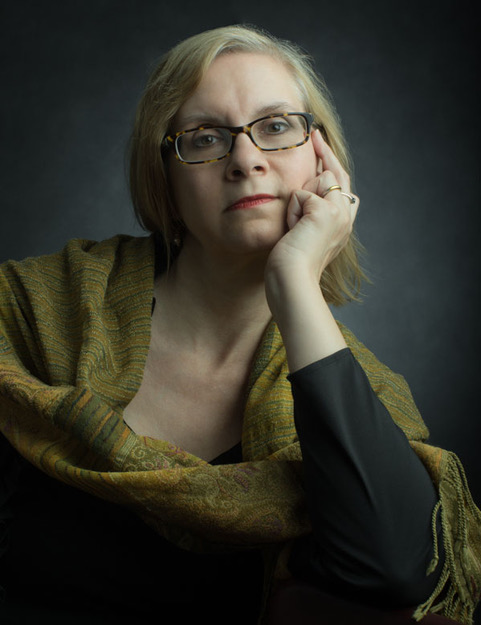
RS: We are so thrilled that you will be joining us for the HNS 2024 UK Conference! What are you looking forward to about the conference? Can you share a teaser for your presentation?
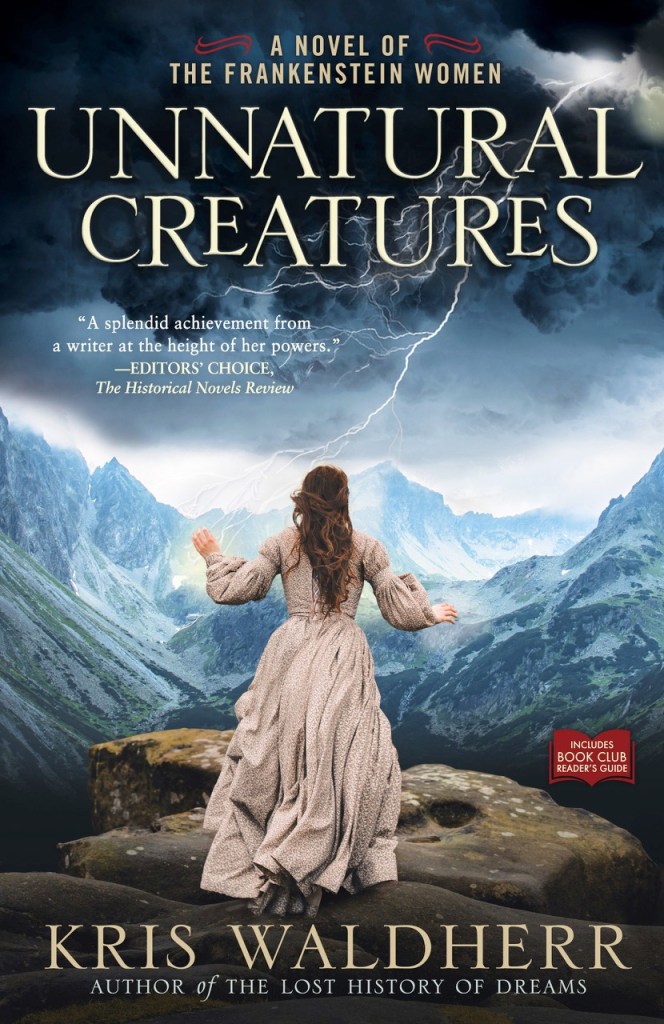
KW: I’m really looking forward to seeing author friends at HNS 2024 UK. I’ve made so many dear friends from previous conferences that HNS always feels like a family reunion! I’ll be presenting Authors as Adaptors with Heather Webb and Finola Austin, where I’ll share about my novel Unnatural Creatures. Unnatural Creatures is a reworking of Mary Shelley’s Frankenstein through the eyes of the three women closest to Victor Frankenstein: his mother Caroline, his bride Elizabeth, and his servant Justine.
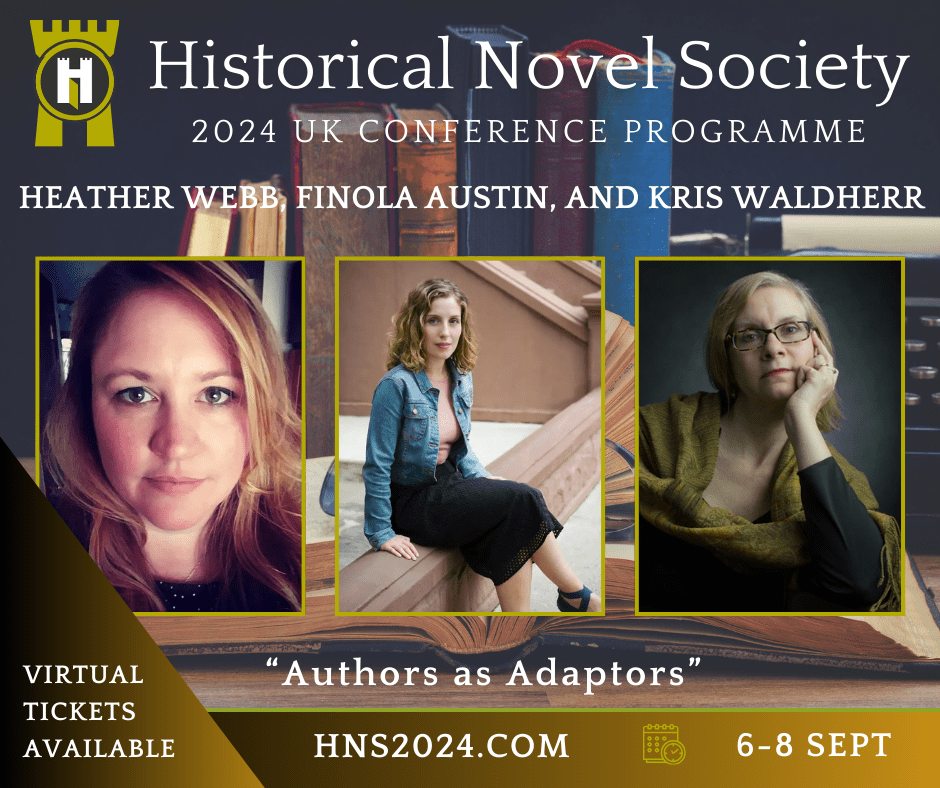
Kris Waldherr is presenting on “Authors as Adaptors”, along with Heather Webb and Finola Austin at the HNS 2024 UK Conference
HNS has launched the First Chapters Competition with the conference. What is a novel you’ve read over your life that unexpectedly grabbed you from the opening lines and whose words stayed with you?
Jane Eyre unquestionably. Charlotte Bronte’s first line is a doozy: “There was no possibility of taking a walk that day.” Jane’s voice is so clear in that first sentence. You can’t help but wonder why was there no possibility of a walk, who couldn’t take that walk, what would happen because they couldn’t take a walk, and so on. Of course, those who have read Jane Eyre know that because Jane couldn’t take a walk that day—it was raining—she’s set upon by her bullying cousin, which leads to Jane being sent to a charity school, where she’s educated in a manner suitable for a governess, which eventually leads to her employment by Rochester, whom she falls in love with. The novel’s entire chain of events are triggered in that first sentence.
Of the wide cast of characters in your novels, who has been your most surprisingly challenging character to write? Why? What strategies did you / do you use for these types of characters?
In Unnatural Creatures, I had a challenging time writing Elizabeth Lavenza, Victor Frankenstein’s unlucky bride. All of the women in Frankenstein feel purposefully underwritten by Shelley, reflecting Victor Frankenstein’s narcissism—they’re all his ideals of femininity, rather than women in their own right. Even after Frankenstein’s most tragic moments, Victor still can’t see Elizabeth as anything more than a reflection of himself: “She was thinner and had lost much of that heavenly vivacity that had before charmed me; but her gentleness and soft looks of compassion made her a more fit companion for one blasted and miserable as I was.” Elizabeth is described as being so beautiful, so perfect, that I really had to dig deep to uncover her depths.
In terms of strategy, I reread all editions of Frankenstein, from Mary Shelley’s 1816 handwritten manuscript draft to her final revised 1831 edition. Each of these offered a different glimpse of Elizabeth, which I stitched together (sorry, couldn’t resist!) to create a more rounded character. I also had to dig deep into her motivations, almost like a method actress. After several drafts and much revision, I finally realized Elizabeth had a lot of internal conflict in regards to the Frankenstein family, especially Victor. After all, she feels so indebted to them because they rescued her from a life of poverty—what choice does she have but to become Victor’s wife?
What do you think it takes to have longevity across a writing career? Sanity? Fun? What’s an unexpected joy that came into your life from such a successful career?
I think the most important factor for longevity is to be very flexible and to expect industry disruptions. Straight out of art school, I worked in publishing as a children’s book illustrator and designer; I never expected to eventually end up writing novels. Nor did I expect that authors would have so many options for publication beyond traditional publishing houses. I also think it’s important to choose your projects from a sense of joy and love. After all, you’ll be living with your book for some time—though of course, you do have to take market into consideration. I usually run my book ideas past my agent and critique partners for a reality check before I get involved too deeply. I also remind myself that nothing is ever personal in publishing, even if it feels such.
Bottom line: Publishing is a business; writing is an art.
Is there a specific scene that you’ve written over the years that you feel especially connected to? If not a specific scene, a secondary story line that was a favorite to write?
In my debut novel The Lost History of Dreams, there’s a scene where a character is overcome by grief after discovering his family home abandoned. He bursts out, “How can there be so much beauty in the world amid so much sorrow?” I think of that line often. The Lost History of Dreams is another reworking of a classic story, this one being the myth of Orpheus and Eurydice. It’s set in 1850 London and involves a post-mortem photographer who’s been sent to uncover the history of a famed poet’s marriage to his muse.
As a historical writer, if you could stand witness to a historical event or walk through a specific time / scene / building or have a frank discussion with one historical figure, which would you choose and why?
I’m obsessed with the Pre-Raphaelites. Before I became a novelist, I was a book illustrator very influenced by their art. I’m fascinated by the relationship between Dante Gabriel Rossetti and Elizabeth Siddal, as well as the artistic partnership of William Morris and Edward Burne-Jones. I’d love to be at one of their gatherings at Red House on a summer night, when they were young and idealistic. If I can have a second choice, I’d also love to be at the Villa Diodati the summer of 1816 with Mary and Shelley and Byron. As you can probably tell, I’m partial to artists and romantics.
What can you share about what you are writing now? Or an upcoming release?
I have two new books underway. The first is Tarot for Storytellers: A Modern Guide for Writers and Other Creatives, which comes out September 2024. Tarot for Storytellers arose from tarot classes and workshops I’ve been teaching to writers since 2019. It’s ultimately about learning to trust your intuition as an artist. (In addition to writing fiction, I have over thirty years experience as a tarotist and am the creator of The Goddess Tarot, which has over a quarter of a million copies in print.) My second book is a historical novel, though it dips toward the magical end of things. It’s set in 1870 Venice and is about two sisters with an unusual family legacy. Finally, I have a short story about Elizabeth Siddal and Dante Gabriel Rossetti in an anthology centered around Edgar Allan Poe’s “The Tell-Tale Heart.” The story is entitled “How They Met Themselves” and will be published October 2024.
What was the last great book that you read?
I’d have to say V.E. Schwab’s The Invisible Life of Addie LaRue, which ping-pongs over so many periods of history via its impossible-to-forget heroine. Another book that’s really stayed with me is Sarah Perry’s The Essex Serpent.
Online tickets for the conference are available:
https://historicalnovelsocietyuk.regfox.com/online
Rebekah Simmers is a member of the HNS UK 2024 conference organisation team. Find out about her novel, The King’s Sword, on her website.
 The Historical Novel Society UK 2024 conference
Leave a comment