
Rebekah Simmers has been interviewing writers who are presenting at the HNS 2024 UK Conference


RS: We are so thrilled that you will be joining us for the HNS 2024 UK Conference! What are you looking forward to about the conference? Can you share a teaser for your presentation?
DS: I trained in drama and dance at Dartington a long time ago, and then went on to do a degree in Theatre Design. After that I worked in the theatre and TV, and found that this experience shaped my novels. For the conference I’m bringing those lessons I learnt from the stage so that I can share them with other writers and readers. I’m hoping to give a little inspiration, or new ways of approaching a scene, and I’m very much looking forward to reconnecting with the beautiful grounds and stunning location of Dartington Hall.

Deborah Swift is presenting “Sparkling Settings & Convincing Costumes” at the HNS 2024 UK Conference in Dartington.
Looking back on your own writing career, what would you say was the most influential writing advice you received from another author? How have you made that work for you?
To have a regular routine – this was suggested to me really early on and is crucial to my way of working. I can’t always be inspired, and the writing doesn’t always flow, but come what may, I’ll be at my desk for the allotted time. And the other obvious advice is to always have a notebook to hand – weirdly, the best ideas often hit me when I’m away from my desk. I’m also still learning my craft (does it ever end?) and I’m a big fan of books on ways of writing. I’m currently reading Sol Stein’s book ‘Stein on Writing’, which although published before the internet really took off, has some excellent advice.
Of the wide cast of characters in your novels, who has been your most surprisingly challenging character to write? Why? What strategies did you / do you use for these types of characters?
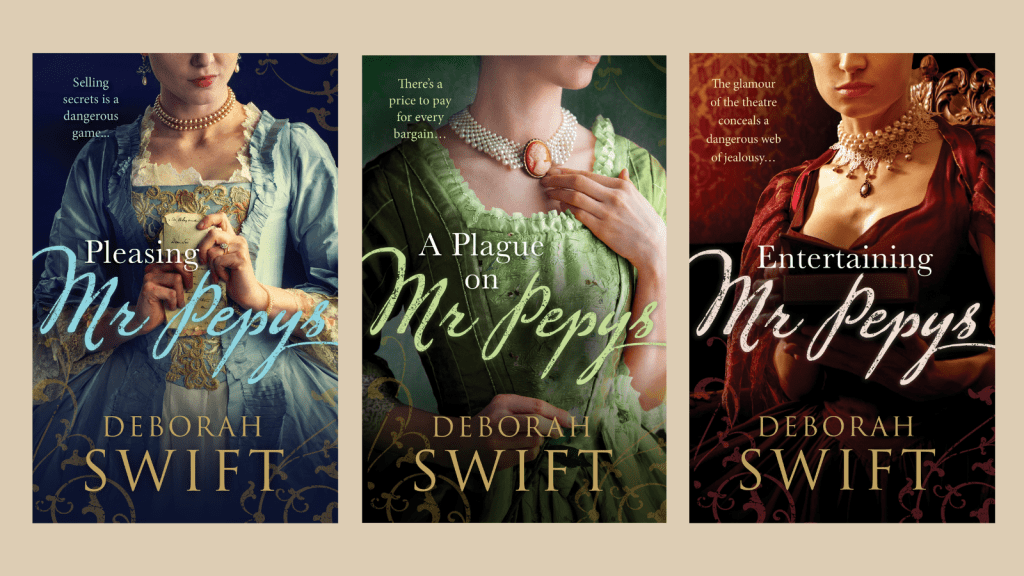
Definitely Samuel Pepys. His diaries had inspired me because of their ‘fly on the wall’ depiction of 17th-century London. His account of the Restoration period is full of the most fascinating details. When I decided to write about the women in his diary, of course he had to appear too, and he was a man who would now be regarded as misogynist, racist and self-serving. He was also greatly loved and respected in his time and those within his orbit would have accepted his views as unsurprising. One of the ways I dealt with this was to use humour, and try to imagine that the women in his life understood his baked-in misogyny and were wise to it, and to use what evidence there is in his diaries to support this interpretation.
What do you think it takes to have longevity across a writing career? Sanity? Fun? What’s an unexpected joy that came into your life from such a successful career?
The main thing is just persistence. A readership takes time to grow, especially if you are not writing in a popular or well-known period. Having other writer friends is really valuable too – someone you can natter with over the plotting, the inevitable one-star reviews and the perils and pitfalls of being published. And yes, you have to be able to laugh. Unexpected joys are those occasional letters from a reader telling me one of my books meant something special to them.
Where do you typically begin your research? Do you have a go-to resource?
Actually I love JStor, the academic website with papers on many obscure subjects. If I’m working on a novel, I browse JStor to find out unusual aspects of the period’s history, and it’s surprising what I can unearth from other people’s historical research. For example I’m currently writing a book set on the Trans-Siberian Express and there are more than 6,000 articles on JStor relating to this topic. It’s a small cost to join the site, and many articles can be browsed online. But I’m also a big fan of real, heavy non-fiction books and often buy these second-hand in hardback.
How do you organize your story details across your series? (Character details, scene research, story lines, etc.)
I am strictly low tech, so it’s all in my rather scruffy notebooks. I don’t like tools like Scrivener and prefer to just use a simple Word Document. I use the comment function on my draft to note the timeline, and my sources such as websites, or page numbers of books I’m using. This saves time when editing, or when anyone queries my research or sources. I save the annotated version before clearing off all the notes and comments and sending a clean version to my agent or editor.

What three books do you feel are necessary for any book collection to feel complete? What additional one would you add for an author’s library?
Mine are pretty obvious choices. I’d have to go for Shakespeare’s Complete Works. His plays are still standing the test of time and include so many themes and possible interpretations. Roget’s Thesaurus. So useful to help find titles, hone word choices and make me boggle at the sheer variety of the English language. Dickens – a collection or any of his long novels because his characters stick and don’t let go. My additional one would be a book of poetry because of the poet’s control of words on the page and also because of the white spaces in which the imagination can roam. If I had to choose one poet it would probably be Ted Hughes for his combination of beauty and brutality.
What can you share about what you are writing now? Or an upcoming release?
My new book Operation Tulip will be out in September just after the conference. It is the last in a series of three WW2 books featuring agents from the Special Operations Executive (SOE). It is set in Nazi-occupied Holland, (did the title give you a clue!), during the ‘Hunger Winter’ at the end of the war.
What was the last great book that you read?
Elektra by Jennifer Saint.
Online tickets for the conference are available:
https://historicalnovelsocietyuk.regfox.com/online
Rebekah Simmers is a member of the HNS UK 2024 conference organisation team. Find out about her novel, The King’s Sword, on her website.
 The Historical Novel Society UK 2024 conference
Leave a comment