
Rebekah Simmers has been interviewing writers who are presenting at the HNS 2024 UK Conference

RS: We are so thrilled that you will be joining us for the HNS 2024 UK Conference! What are you looking forward to about the conference? Can you share a teaser for your presentation?
ADR: Attending the 2024 HNS conference in the UK is a dream come true, and it’s a huge honor to present at an event headlined by some of our author heroes in the genre. We cannot wait to connect with other historical fiction writers and readers, and we’re excited about the conference’s unique theme—one that feels very relevant to writers who wish to pursue a long-term author career.
Our presentation on “How to Co-write a Historical Novel” will be an unflinchingly honest look at both the joys and pitfalls of co-writing with another author… all without destroying your relationship! Co-writing can be a useful collaborative skill to have in your writing toolbox, especially in today’s publishing landscape. Most other types of artists have collaborated for centuries, but it’s a fairly new option for authors. Even if writers occasionally collaborated in the past, the technological tools that make the process so easy today simply weren’t available. (If they had been, can you imagine J.R.R. Tolkien and C.S. Lewis sharing a Google Doc?). We believe co-writing is an unsung superpower; it can help you publish more frequently and write the sweeping, more cinematic stories that tend to appeal to a broad audience in our Golden Age of streaming TV. Our workshop’s purpose is to help writers determine if co-writing is right for them, how to decide on the right project and collaborative partner, and what strategies and tips helped us co-write two doorstopper epics in under a year.

HNS has launched the First Chapters Competition with the conference. What is a novel you’ve read over your life that unexpectedly grabbed you from the opening lines and whose words stayed with you?
The most memorable opening lines we’ve read belong to the Queen of Australian Young Adult fiction, Melina Marchetta, from her masterpiece, Jellicoe Road:
“My father took one hundred and thirty-two minutes to die. I counted. It happened on the Jellicoe Road. The prettiest road I’d ever seen, where the trees made breezy canopies like a tunnel to Shangri-La.”

A.D. Rhine, the co-author team of Ashlee Cowles and Danielle Stinson, is presenting on “Co-Writing Historical Fiction” at the HNS 2024 UK Conference.
Looking back on your own writing career, what would you say was the most influential writing advice you received from another author? How have you made that work for you?
The best writing advice we’ve received is… take all writing advice with a grain of salt! By all means, learn constantly and stay open to the hard-earned wisdom shared by writers you respect. At the same time, the amount of input can quickly become overwhelming, and many of our own “wins” in this industry have come from listening to our guts. That said, we are both huge Steven Pressfield fans and find his advice on overcoming the Resistance (cough, research rabbit holes) that can keep us from the hard work of storytelling is spot on.
Of the wide cast of characters in your novels, who has been your most surprisingly challenging character to write? Why? What strategies did you / do you use for these types of characters?
The most challenging characters (who we cannot even name without spoiling things) for us to write in both Horses of Fire and Daughters of Bronze were those who narrated the small sections of poetry placed strategically throughout both novels. Each novel contains one of these “Hawk” characters, whose bird’s eye view of events reveals things to the reader that our narrators cannot see. In a sense, these mystery characters created a story within a story, laying out clues for the reader that come together at the very end. On top of that balance of mystery/reveal, they needed powerful arcs of their own. Some of the most complex character-building and storytelling in these books had to be done in the least amount of space. We sweated over every word. Some sections remained untouched from the very first iteration. Others we worked and reworked and worked again. In the end, sheer persistence won the day.
What do you think it takes to have longevity across a writing career? Sanity? Fun? What’s an unexpected joy that came into your life from such a successful career?
For longevity in this business, you have to love what you do and protect that love at all costs. For us, the joy and wonder we draw upon each time we sit down to write is the same joy and wonder we discovered within books as young readers. It is the True Magic we believe in, and it lives in a realm completely separate from publishing and the business side of this work. To protect the magic source of our creative spark, we constantly remind ourselves that art is mostly subjective and deeply personal. While we love interacting with readers on social media, attending events, and watching our books find new audiences, we also have felt the sting of rejection and the negativity that is part of sharing anything with the world. We have learned to gauge exactly when it’s time to huddle up and protect that little flame against the wind. Publishing is notoriously fickle, even for the most established of authors. Success in this business often has less to do with merit than luck and timing. That’s why it is so important to keep that fire burning for yourself in whatever ways work best—often this involves finding a community of writer friends (that’s why we love conferences!) who will help you tend the flame.
Where do you typically begin your research? Do you have a go-to resource? Has there been anything that you’ve researched for your writing over the years that made a huge impact on you or a novel or series that you were writing? That changed how you write or what you write?
We both start by reading a lot of non-fiction history that gives us a general sense of the time period and setting. We also watch films/TV set during the era to give us a sense of atmosphere and “mood.” (Our dream, of course, would be to visit ALL the locations where our stories are set!) For us, the trick is to do just enough research upfront to “find the story,” but not get bogged down by details that we feel like we can’t write one scene without stopping every 5 minutes to look something up. That depth of research comes later after we have a first draft and know the heart of the story.
How do you organize your story details across your series?
We are extremely old school in our approach, and walk the tightrope suspended between chaos and order. Between us, we have dozens of notebooks crammed full of barely legible notes and historical details. From these we compile countless shared Google docs.
We strongly believe that you cannot understand a historical event or period without an in-depth knowledge of the centuries and millennia that preceded it. And so, we always begin our deep research phase by rewinding way back from the period we are covering in the hopes of better understanding all the forces and events that led to this moment in history. For Horses of Fire and Daughters of Bronze, this required us to go all the way back to the very first human civilizations in Mesopotamia and Anatolia. Only through studying what the Trojans themselves would have considered “ancient” could we truly capture their lost world in a way that felt authentic to the reader.
Is there a specific scene that you’ve written over the years that you feel especially connected to? If not a specific scene, a secondary storyline that was a favorite to write?
The ending of Daughters of Bronze without a doubt (we must be vague to avoid spoilers!). We knew what that scene would be from the very beginning, and it’s what every single word in both Horses of Fire and Daughters of Bronze is moving toward. If you’re familiar with Homer’s Iliad, you already know it ends tragically for the Trojans. Our task was to make the story riveting and unexpected even for those who *think* they know how this ancient tale will go. To that end, our duology roots the mythology in Bronze Age history and tells the Trojan side over that of the “victors” who passed down the events of this war—events likely based on an actual historical catastrophe. Additionally, something about the way Prince Hector was portrayed in the Iliad never quite made sense to us, so our ending was a way to explore that disconnect and give the Trojans a thread of hope, while still honoring the main moments and spirit of Homer’s original story.
As a historical writer, if you could stand witness to a historical event or walk through a specific time / scene / building or have a frank discussion with one historical figure, which would you choose and why?
Ashlee: The impossible question! A lot of events and people come to mind, but because I’m drawn to the unsolved mysteries of history, it would be fascinating to witness what really happened to the crew who vanished from the Mary Celeste “ghost ship”… or perhaps not, since I’d then have to be aboard it!
Danielle: As strange as it probably sounds, I would want to visit the late neolithic period to find out what really happened to the Neanderthals. Every generation tends to view itself as the most highly evolved, but it is my personal belief that we could learn a great deal about ourselves and our world from our earliest ancestors and the beings who, for a time, walked the earth beside them.
What three books do you feel are necessary for any book collection to feel complete? What additional one would you add for an author’s library?
Danielle: This question is both fabulous and impossible. The best thing about having a co-author is you get to defer to them in moments like this. *passes the buck to Ashlee
Ashlee: Three novels that made me want to write historical fiction are: Kristin Lavransdatter by Sigrid Undset, Doomsday Book by Connie Willis, and The Poisonwood Bible by Barbara Kingsolver. For all authors, I’d recommend The Heroine’s Journey by Maureen Murdock (Gail Carriger’s craft book of the same title is even more specific to commercial fiction). We hear a lot about the Hero’s Journey, but there’s a whole other half to the archetypal “journey” present in myths and fairy tales that can shape how we create characters readers will connect with on a deep level.
What can you share about what you are writing now? Or an upcoming release?
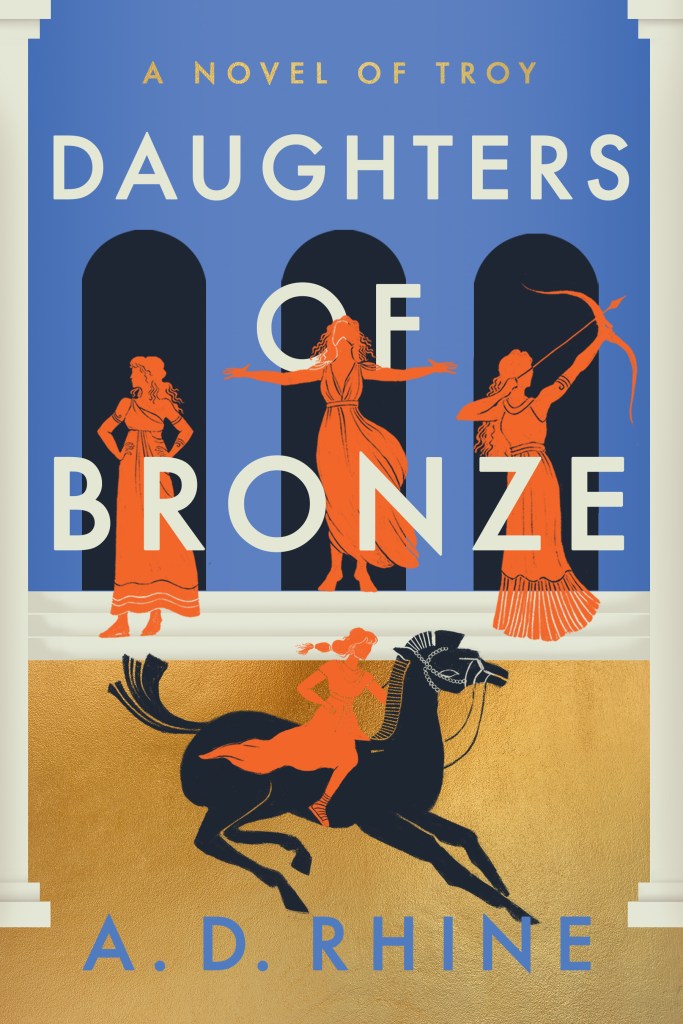
The second half of our Trojan War duology, Daughters of Bronze, will be published by Dutton/PRH in November 2024. We also have a few new co-authored projects in the works and are excited to see which one will take the lead. All we can say for now is that one of them incorporates our personal history of growing up on U.S. military bases in Germany even more explicitly. While this project would mean exploring a more recent period, the elements readers encountered in our first two books will carry over: the power of unlikely female friendships, small acts of great courage by unsung heroes, and the unexpected ways the ancient past continues to impact later time periods.
What was the last great book that you read?
Ashlee: Between Two Fires by Christopher Buehlman. Set in 14th-century France during the Black Death, this historical novel with strong supernatural elements of horror isn’t for the faint of heart, but it is brilliant. The most propulsive read I’ve experienced in a long time.
Danielle: I read The Virtues of War by Steven Pressfield years ago, but I recently listened to the audiobook version in the car while driving my teenage son back and forth from various soccer fields. My oldest is a military history nerd just like his parents. I had secret hopes to capture his attention but wasn’t going to hold my breath. Watching him listen to Alexander the Great’s story was a reminder of the incredible timelessness of that book.
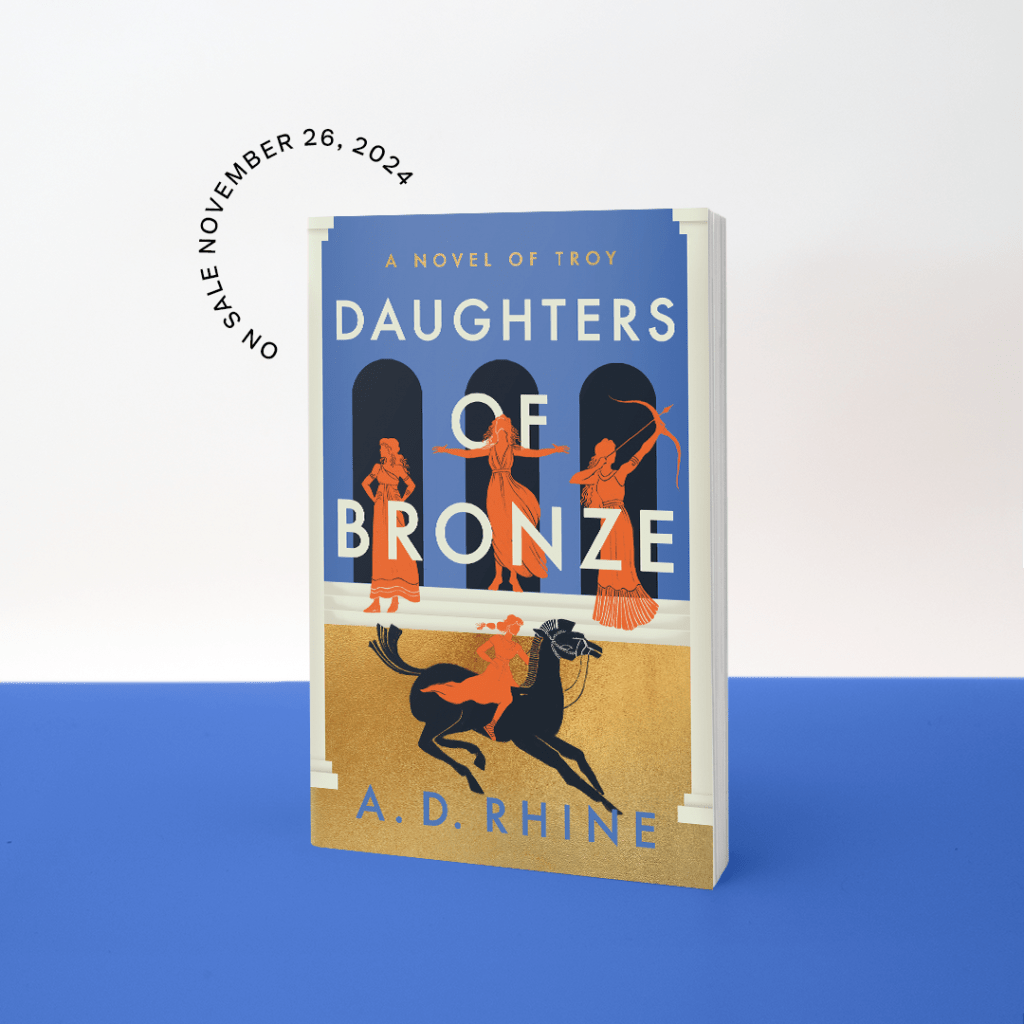
Daughters of Bronze, the second installment of our historically-rooted duology of the Trojan War and sequel to Horses of Fire, will be published by Penguin-Random House in November 2024. Readers can find bonuses like downloadable maps, discussion guides, and info about having us “Zoom in” to your book club at https://www.adrhine.com/.
Online tickets for the conference are available:
https://historicalnovelsocietyuk.regfox.com/online
Rebekah Simmers is a member of the HNS UK 2024 conference organisation team. Find out about her novel, The King’s Sword, on her website.
 The Historical Novel Society UK 2024 conference
Leave a comment