
Rebekah Simmers has been interviewing writers who are presenting at the HNS 2024 UK Conference

RS: We are so thrilled that you will be joining us for the HNS 2024 UK Conference! What are you looking forward to about the conference? Can you share a teaser for your presentation?
MJP: I’m looking forward to the conference as it’s in a location I’ve never visited before, and the HNS conferences are always wonderful places to meet fellow authors and chat about all things writing and historical fiction (and history).
Alongside my Dad, Michael Cooke, ‘Mapman Michael’ we will be sharing some antiquarian maps of England and Britain as a whole and the US states, as well as some other locations. I make great use of antiquarian maps to recreate the locations I take my characters to in Saxon England, and I want to share those ideas with fellow attendees as I find them invaluable in removing the ‘noise’ of modern buildings and road and river systems.
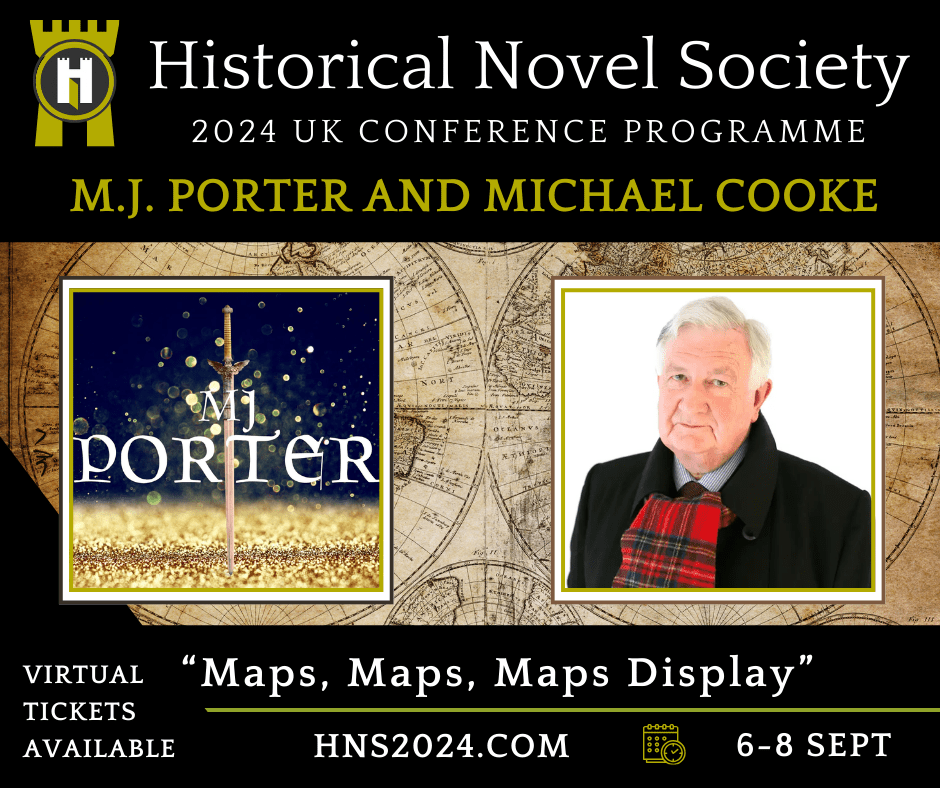
MJ Porter and her father Michael Cooke will present a display a collection of historical maps at the HNS 2024 UK Conference
HNS has launched the First Chapters Competition with the conference. What is a novel you’ve read over your life that unexpectedly grabbed you from the opening lines and whose words stayed with you?
Wuthering Heights is about the only novel that I can quote from the beginning. I’ve not read it for years, and actually don’t want to, but it was certainly very influential on me when I was first picking out the stories that I enjoyed. And, indeed, it’s the description of Wuthering Heights that I can quote. As someone who doesn’t like too much description, this long sentence has taught me how much can be compacted very quickly to set the scene for the reader. It’s something I try and employ when writing.
What do you think it takes to have longevity across a writing career? Sanity? Fun? What’s an unexpected joy that came into your life from such a successful career?
A strong work ethic is imperative as without one, writers never do any writing. Set deadlines and stick to them. I would never have written as many books as I have unless I’d been very strict with myself. These routines certainly helped when I then started to work with a publisher as I know what I can accomplish in a certain amount of times.
It’s also important to enjoy your characters. If you don’t readers will certainly never love them and want to read about them.
And this is one of my joys from writing. King Coelwulf II of Mercia, my very sweary and brutal character, who has brought me a great deal of success, is loved by my readers, but more importantly, he brings me so much joy to write. I find it a real treat to work on his stories. They’re not really work at all.
Where do you typically begin your research? Do you have a go-to resource? Has there been anything that you’ve researched for your writing over the years that made a huge impact on you or a novel or series that you were writing? That changed how you write or what you write?
I never intended to write historical fiction. Instead, I wanted to write fantasy, admittedly with a strong historical basis (an alternative Viking-age Iceland anyone?), but when I was studying for my Masters degree, I discovered my first historical character that I felt I needed to fictionalise, Ealdorman Leofwine of the Hwicce (a part of Mercia). He and his family should be much better known, as the only family to survive for the last 100 years of Saxon England. Alas, their accomplishments have been overshadowed by the powerful Godwine family. I decided to set about changing that, and since then, I’ve continued to explore Mercian history, and Saxon England as a whole. I am a little bit obsessed with Mercia.
I begin my stories by looking at the events recorded in the source material, usually the Anglo-Saxon Chronicle but sometimes Bede’s Ecclesiastical History of the English People (although I take everything they both say with a pinch of salt).
From there I have a huge library of non-fiction titles, which is constantly growing, but my next favourite resources are two online ones, PASE and the Electronic Sawyer. I use them to check ‘facts’ and also to ‘borrow’ names for fictional characters. I often employ different tactics, however, sometimes I intend to ‘fill’ gaps in the historical record, and other times I want to explore the ‘bias’ in what knowledge we do have.

How do you organize your story details across your series?
I’ve always been particularly bad at this, which doesn’t help when writing multiple series at different times. I’ve tried the ‘sticky note’ and wooden board approach but now I use spreadsheets and try and capture relevant information when I’m working on copyedits and proofreads. It’s not always correct and sometimes I do have to spend a lot of time tracking down small details. I live in fear of resurrecting a character I’ve killed off in earlier books. My advice is to start strong with characters’ profiles and ‘book bibles’ for each title, i.e., don’t do what I did.

Is there a specific scene that you’ve written over the years that you feel especially connected to? If not a specific scene, a secondary story line that was a favorite to write?
My secondary storyline has grown into a huge series, independent to the one my character, Icel, first appeared in. Originally, he was hugely important to my The Last King series/The Mercian Ninth Century (it has a few titles). When I started to work with Boldwood Books, they were keen for me to pitch a new series, and so I took Icel back to his childhood (nearly forty years earlier), and I’ve had so much fun.
As I’m still writing both series, I can intermingle storylines into the two series which fans of both series will enjoy (and probably have a giggle about) while not adding details people who only read one series won’t understand. So, Icel, has been hugely important to me, and he is also one of only a few truly fictional characters I’ve ever written, as the vast majority are based on ‘real’ people.
As a historical writer, if you could stand witness to a historical event or walk through a specific time / scene / building or have a frank discussion with one historical figure, which would you choose and why?
I’ve never really had an answer to this before, but having had great fun recreating Constantin II, King of the Scots from c.900-943, in my Brunanburh series, I would now really like to meet him just to find out if he’s as devious as I’ve portrayed him in my books. I hope he was truly as flexible with his thinking and alliances.
What can you share about what you are writing now? Or an upcoming release?
I am currently working on a new trilogy that I will be happy for everyone to term as set in the Dark Ages, as it really is, in sixth century England. (I am a bit pedantic about what is and isn’t truly the Dark Ages). Book 1 is with my editor and I am pressing on with Book 2. This is a passion project for me, and one I’ve been amassing research for years to be able to write. I think it should probably be termed ‘archaeological fiction’ because there is almost nothing written about this period.
What was the last great book that you read?
Not historical fiction but I read an advanced copy of Susie Dent’s new title and I loved it. I really think it will appeal to historical fiction readers as well as mystery fans. (I’m not usually a fan of celebrity mystery books but I read this one in two days.) It’s set in Oxford, and includes wonderful scenes about words and their provenance – which I think all historical authors (and readers) like to argue about.
Online tickets for the conference are available:
https://historicalnovelsocietyuk.regfox.com/online
Rebekah Simmers is a member of the HNS UK 2024 conference organisation team. Find out about her novel, The King’s Sword, on her website.
 The Historical Novel Society UK 2024 conference
Leave a comment