
Rebekah Simmers has been interviewing writers who are presenting at the HNS 2024 UK Conference


RS: We are so thrilled that you will be joining us for the HNS 2024 UK Conference! What are you looking forward to about the conference? Can you share a teaser for your presentation?
MJ: It was many years ago, back in 1995 or 1996 that I first met Richard Lee and started talking about his idea for a society based around historical novels. Since then, the group has grown so massive, I’m just really looking forward to meeting historical enthusiasts and talking about books!
The conference itself is so full of fabulous talkers and panels, I’m really looking forward to attending several, especially listening to Matthew Harffy, Elizabeth Chadwick, Derek Birks, Ian Mortimer and, of course, Bernard Cornwell.
As to my presentation, it’ll be more about how to research a novel, where to get the information you need, how to get inspiration, and basically how I write my own novels. It will appeal to aspiring authors and those who just want to find out how authors produce their books, and I’m looking forward to a lot of audience interaction!
Michael Jecks is presenting “Writing Historical Fiction in Devon” at the HNS 2024 UK Conference
HNS has launched the First Chapters Competition with the conference. What is a novel you’ve read over your life that unexpectedly grabbed you from the opening lines and whose words stayed with you?
It has to be George MacDonald’s first Flashman book, in which he sets out the scene superbly with the horrible coward, cheat and womaniser Harry Flashman. Since Flashy is taken from the bully of Tom Brown’s Schooldays, MacDonald is keen to set the record straight:
“Hughes got it wrong, in one important detail. You will have read,
in Tom Brown, how I was expelled from Rugby School for drunkenness, which is true enough, but when Hughes alleges that this was the result of my deliberately pouring beer on top of gin-punch, he is in error.
I knew better than to mix my drinks, even at seventeen.
“I mention this, not in self-defence, but in the interests of strict truth.
This story will be completely truthful; I am breaking the habit of eighty years. Why shouldn’t I? When a man is as old as I am, and knows himself thoroughly for what he was and is, he doesn’t care much.”
Looking back on your own writing career, what would you say was the most influential writing advice you received from another author? How have you made that work for you?
It must have been my first agent, who told me once that the most important thing for a writer was not the latest contract, not the amount of the advance, not the adulation of readers – but the fact of sitting down for a number of hours every day and writing. Because if you want to have the honour of being called a writer, you have to actually do the job.

I spent several years as a salesman, and I am fortunate to have the experience of a “real” job, so I am quite happy to sit at my desk and start typing every morning. Sometimes the words suffer from the “delete” key, but I do work every day to try to improve my writing and my stories.
Of the wide cast of characters in your novels, who has been your most surprisingly challenging character to write? Why? What strategies did you / do you use for these types of characters?
Some years ago I created a trilogy set during the Hundred Years War: first was FIELDS OF GLORY, then BLOOD ON THE SAND, and finally BLOOD OF THE INNOCENTS. These were enormously hard to write, covering Crecy, Calais, and then ten years later, the battle of Poitiers.
The concept was, to show how brutal the war was, how it affected all those involved in the earlier stages, and then the impact ten years later, after the horrors of mercenary bands looting and murdering all across France, and the plague hitting Europe.
I had not expected it to be so hard, because I had written many books already involving death and murder, but trying to find humanity in the characters of the British archers, that was enormously difficult. I have to say, it’s now a group of work that I’m very proud of.
What do you think it takes to have longevity across a writing career? Sanity? Fun? What’s an unexpected joy that came into your life from such a successful career?
Determination and a goodly measure of luck as well as damn hard work. Sitting down and writing 120,000 words is not easy! But it does bring joy and a lot of friends. I have been blessed with a lot of great friends I’ve met all over the world as a result of my writings.
The greatest shocks came from being invited to go to Canada to be the international guest of honour at the Bloody Words Festival; and the same year, 2014, I was the Grand Marshall of the first parade of the New Orleans Mardi Gras. That was entirely unexpected!
Where do you typically begin your research? Do you have a go-to resource? Has there been anything that you’ve researched for your writing over the years that made a huge impact on you or a novel or series that you were writing? That changed how you write or what you write?
My main resources tend to be libraries – including my own. I have here, in my office, over ninety bookshelves with research material of all types: the history of warfare, the history of swords and sword manufacture, social structures in the 1300s, the OXFORD BOOK OF VILLAINS, the history of the Isles of Scilly … and many, many more. As to which books have most impacted me and my writing, probably that was DUNGEON, FIRE AND SWORD by John J. Robinson, a superb summary of the history of the Knights Templar, and the inspiration for my first novel with Sir Baldwin. It directly led to my realisation that I was a historical writer.
How do you organize your story details across your series?
Very haphazardly, to be honest. As an author, I am frankly hopeless at anything involving administration. Filing and sorting are things that happen to other people!
I tend to use Scrivener as my main writing tool, and in that I will make a project note that includes the names of all my characters for the book (including copying and pasting the names of the main characters, their birthdays and physical traits). It is always there, on the right hand side of my screen as I type – and I still get things wrong, somehow. All I can say is, thank God for a good copyeditor!
Is there a specific scene that you’ve written over the years that you feel especially connected to? If not a specific scene, a secondary story line that was a favorite to write?
Across some sixty plus actual stories (if I include novellas and short stories), I have too many to mention one or two specific ones. I loved the three paviours I introduced in DEATHSHIP OF DARTMOUTH, my 21st TEMPLAR story, just as I loved Sir Richard de Welles, the coroner I invented for that story – a mix of Brian Blessed and James Robertson Justice, a character who made me laugh out loud as I was writing him.
There have also been several scenes into which I have thrown poor Jack Blackjack from my current BLOODY MARY TUDOR series, the poor devil, which really have entertained me as an author!
As a historical writer, if you could stand witness to a historical event or walk through a specific time / scene / building or have a frank discussion with one historical figure, which would you choose and why?
I would have to pick the day of the death of Jacques de Molay, the last Grand Master of the Knights Templar, executed at the order of the King of France. Why pick that gruesome scene? Because I would dearly love to know the truth of the reaction of the crowds at his declaration of his own and his Order’s innocence.
And if it were possible to talk to someone, it would be wonderful to have spoken to him the night before his execution. Did he recant on the scaffold, at which he had been supposed to admit his guilt, which would have meant he had a reasonable retirement ahead of him, or did he decide earlier, from a sense of deep betrayal?
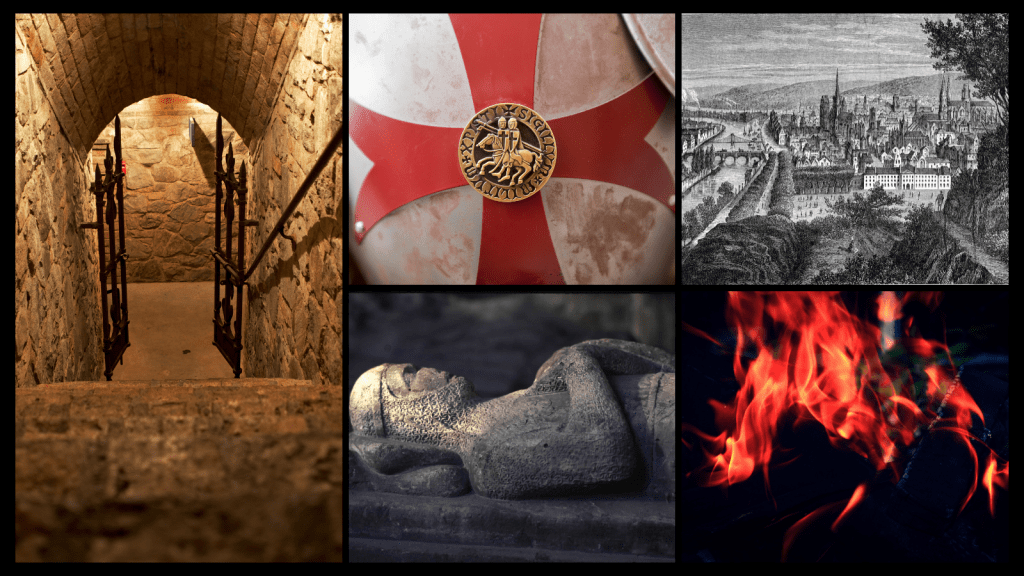
Failing Jacques, I have to admit, I would dearly love to have met Sir John de Sully, a local magnate here in Devon. He owned the manors of Sandford and Iddesleigh, and had a glorious career as a warrior, serving in most of the major battles from Bannockburn onwards. Later, he became one of the founder members of the Order of the Garter, and an honoured member of the Black Prince’s household.
But his key interest, to me, was his life – because he was born in 1283 and lived to 1388. He witnessed so much in his lifetime – the end of the power of the magnates over serfs, the great European famines of 1315-1321, the Hundred Years War, the plague … what a story he had to tell!
What three books do you feel are necessary for any book collection to feel complete? What additional one would you add for an author’s library?
LORD OF THE RINGS; DUNE; THE LONG KISS GOODBYE. No bookshelf is complete without them. To be fair, almost any Raymond Chandler would do, but that one is my favourite. As to one more: QUARTERED SAFE OUT HERE – another book by George MacDonald Fraser. It’s his memoir of his service in the Burma campaign during the Second World War, and it’s a marvellous evocation of the period, of the lives of ordinary soldiers, and of the feelings of the men who joined the battles under General Slim.
What can you share about what you are writing now? Or an upcoming release?
I am just finishing up the ninth in the Jack Blackjack series, DEATH COMES IN THREES (feel free to pre-order!); at the same time I am writing the third in my Art of Murder series, which is cautiously titled “Untitled Book Three”, and will remain so until inspiration strikes. That has to be completed by end September, when I have to start a new book, which will be a collaborative story written with a famous person and set firmly in the musical industry – but I can’t say more than that yet!
What was the last great book that you read?
SQUADRON: ENDING THE AFRICAN SLAVE TRADE by John Broich – a history of the Royal Navy’s fight against slavers off the East African coast. I was really gripped by this book. Well worth a read.
Online tickets for the conference are available:
https://historicalnovelsocietyuk.regfox.com/online
Rebekah Simmers is a member of the HNS UK 2024 conference organisation team. Find out about her novel, The King’s Sword, on her website.
 The Historical Novel Society UK 2024 conference
Leave a comment