Rebekah Simmers is interviewing presenters from the HNS 2024 UK Conference.

RS: We are so thrilled that you will be joining us for the HNS 2024 UK Conference! What are you looking forward to about the conference?
Matthew: Everything! I’m looking forward to meeting so many interesting people in the world of historical fiction. There are lots of fabulous talks and I can’t wait to chat with some of the wonderful authors attending. I’m also excited to meet up with old friends from previous conferences and festivals. Oh, and of course, I’m looking forward to finally getting to meet Steven in real life!
Steven: Yeah, as Matthew says, we’ve never met despite doing the podcast together for over two years now, so it’ll be good to finally meet in person! As for the conference itself, I think it’ll be great to chat with all the amazing authors and other fans of historical fiction that’ll be there. We’ve spoken with a few already on the podcast so it’ll be nice to catch up again. On top of that, the actual location, in leafy Devon, looks like paradise for me!
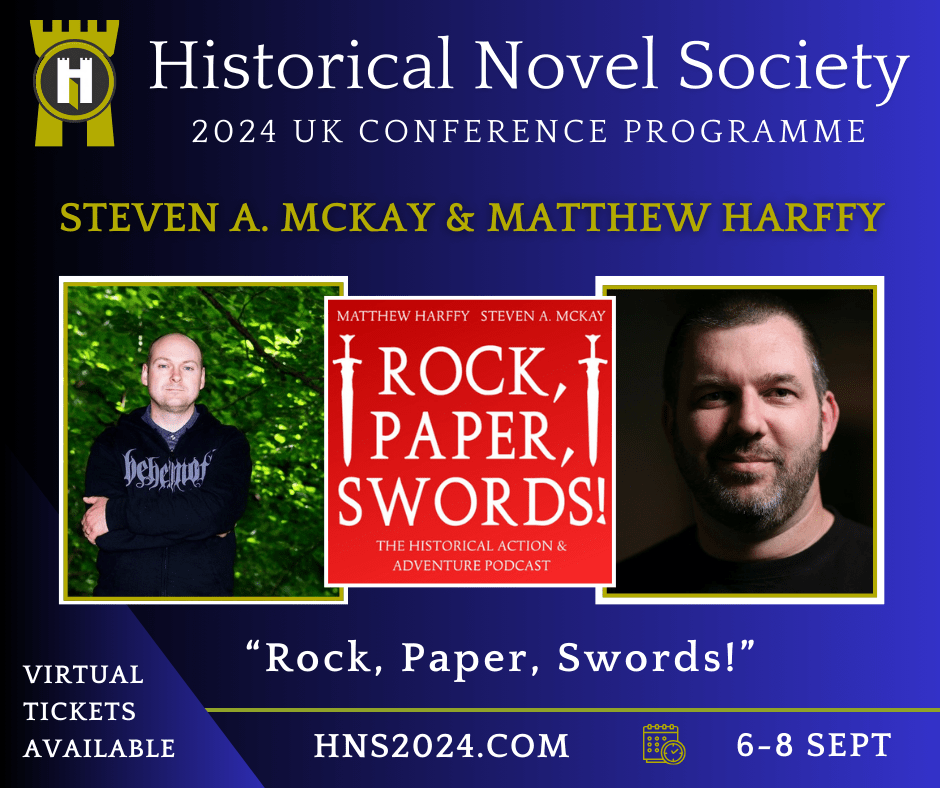
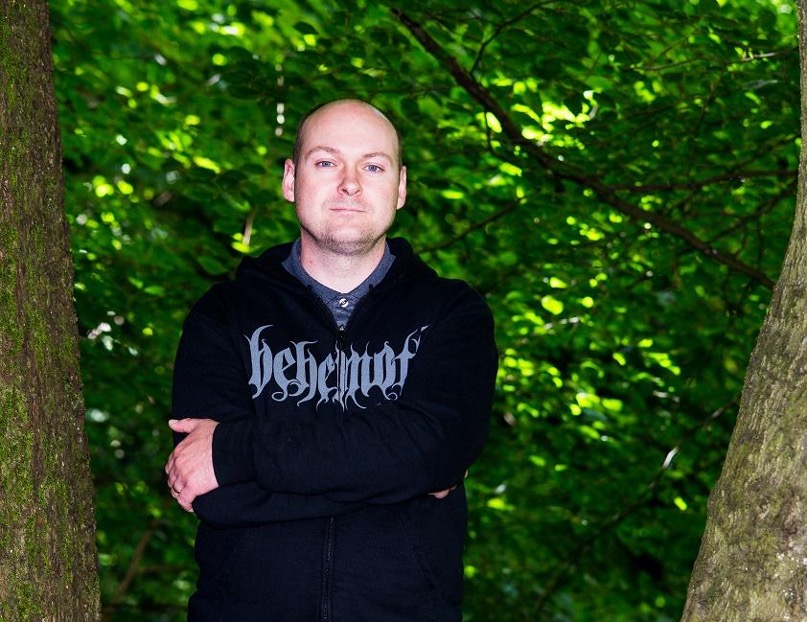
Steven A. McKay and Matthew Harffy will be broadcasting their Rock, Paper, Swords! Podcast from the HNS 2024 UK Conference.
Matthew Harffy is also part of the Writing Medieval Panel – Derek Birks & Sharon Bennett Connolly in conversation with Elizabeth Chadwick, David Gilman and Matthew Harffy
You’re doing the Rock, Paper, Swords! Roving Podcast at the conference. Where can people who are interested find and listen to your podcast? Will you be live-streaming? Will people be able to access the interviews at a later time then? Is there a subscription service?
The podcast is available on all popular platforms, such as Apple Podcasts, Spotify, Amazon Music and many others. There are links on the podcast’s website: https://podcasters.spotify.com/pod/show/rockpaperswords
We might be livestreaming at the conference, but our focus is going to be capturing interviews and reviews of the different sessions. The HNS Conference episodes will take a while to edit and release and will be available on all platforms afterwards.
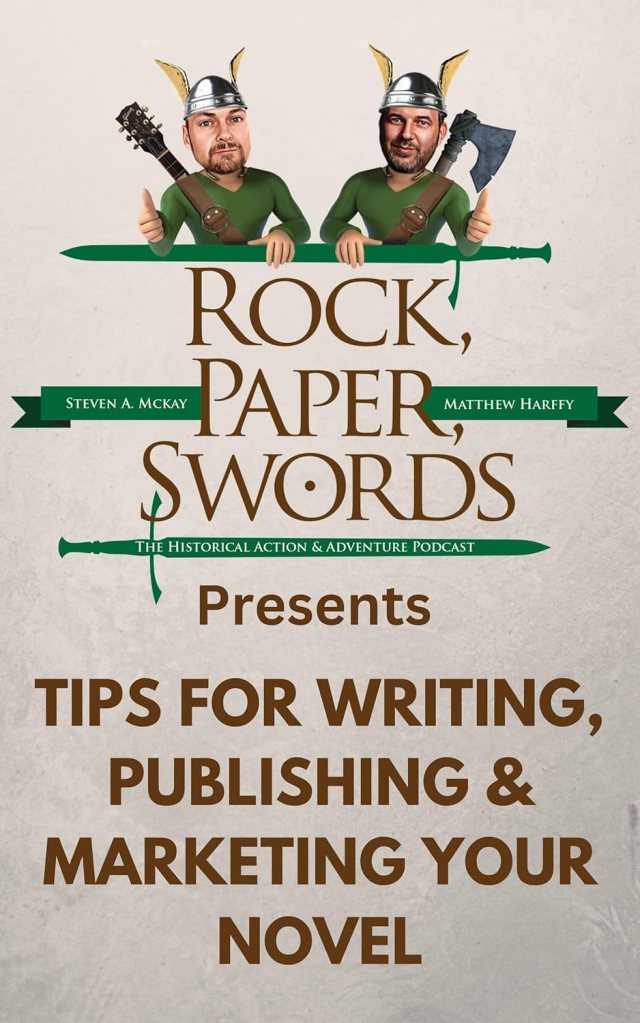
Rock, Paper, Swords! has a Patreon page where we release a bonus episode each month. Subscribers can access all past bonus episodes and get a free copy of our book Tips on Writing, Publishing and Marketing your Book. Depending how much content we get from the HNS Conference, there may well be an HNS-themed bonus episode on Patreon.
Can you share with us a little bit about how your podcast came to be? How did you two come together and what inspired you to create an action and adventure podcast?
Matthew: As we both work as writers full-time, which means we spend a lot of time on our own and have no work colleagues to chat with everyday, it seemed like a good way to socialise with someone who had similar interests. The theme of the podcast is pretty open ended, covering history, action and adventure and rock music. Basically anything that we both enjoy!
It has allowed us to meet amazing people who we would have no chance of meeting without the podcast. We have been blessed with some wonderful guests from the historical fiction world, such as Bernard Cornwell, Simon Scarrow and Robyn Young, and from the musical world, such as Todd Kerns from Slash’s band and none other than Ian Anderson of Jethro Tull.
It certainly means we speak to more people than we would if we were just writing, and it keeps us busy!
Steven: One thing that I’ve noticed myself, and that other authors have told us on the podcast, is that being a full-time author is a very solitary occupation. I used to spend all day out working around Glasgow, chatting to people, driving about and seeing different places, and feeling like I was a part of the community. Now, I spend my days pretty much alone, writing, and it can be a little bit lonely! So I thought the podcast would be a good way to meet new people, even if only virtually. It’s certainly been great in that respect.
For those not familiar with podcasts in general, can you give us a bit of the behind the scenes of how it works? What can someone expect as a listener? Or as someone being interviewed?
Steven: It’s really just like a chat down the pub, or at least that’s how we tend to approach it. We record it and edit it later so if an interviewee says something they want taken out it’s not a problem. Knowing it’s recorded and edited and not just published ‘as is’ lets people relax a bit, without fear of saying anything silly or embarrassing! We tend to spend a few hours researching the guests and come up with questions together, trying to make them interesting for the guest, the listeners AND ourselves. We feel like an hour is the ideal time for a chat and it’s just a fun time and hopefully a good experience for everyone involved. Some guests can be shy or very anxious about coming on but we’ve managed to put them all at ease so far, and sometimes it’s US who are anxious, like when we interviewed Jethro Tull’s Ian Anderson or big names like Bernard Cornwell! Ultimately, we want to promote our guests and make episodes people will enjoy listening to.
I saw on your site that you like to have fun with your podcasts and hope to cover things for writers and readers both. What do you think is the greatest part of the podcast experience? Unexpected perks? Challenges?
We do the podcast to have fun, so we keep things light, but always remembering that each episode has to be interesting and fun for the listeners too. We quickly learnt not to talk over each other and not to descend into fits of giggles when we found something particularly funny – or at least to edit those bits out, as that can get boring pretty quickly.
The best part of doing the podcast is that we have got to chat with some truly brilliant writers, musicians and historians. We’ve interviewed some of our heroes, which has been truly amazing.
What advice would you give to someone preparing for a podcast? What do you think your listeners can look forward to from the conference? Is there anything that you’re particularly excited to share?
Being a guest on a podcast should be fun. It is normal to get nervous beforehand, particularly if you are not that experienced, but the best advice is to prepare some of your answers beforehand. If you can, get the questions in advance, which allows you to feel much more relaxed. If you don’t have access to the questions, prepare for things you are sure to be asked about, such as the history behind your latest novel.
Listeners can look forward to some wonderful guest interviews, reportage from the event, and hopefully we’ll capture some of the buzz and excitement of the conference.
We’ve already lined up some of the big name speakers for interviews, but you can never tell what interview will provide the best content. We’re looking forward to everything!
HNS has launched the First Chapters Competition with the conference. What is a novel you’ve read over your life that unexpectedly grabbed you from the opening lines and whose words stayed with you?
Steven: I think the most famous one is the opening line from Rebecca by Daphne Du Maurier: “Last night I dreamt I went to Manderley again.” It’s a line that’s drawn in so many people and I’m one of them, rather to my surprise. I had listened to the audiobook of Jane Eyre and was amazed to find I enjoyed it (I didn’t think I would, being a man who reads mostly action and adventure, not ‘romance’). After that I wanted something similar and Rebecca was recommended. Those two novels were nothing like what I would usually read, but I loved them, and they inspired me to write something along those lines myself (Lucia). It just goes to show that it’s always a good idea as an author to try books outside your favourite genre – you never know what might inspire you!
Matthew: First lines are incredibly important. I love to start things off with a bang, and an unanswered question to draw readers in. One great opening line that comes to mind now is from Ken Follett’s The Pillars of the Earth: “The small boys came early to the hanging.” There is just so much going on there that makes you want to read more and sets the scene for the world in which the book takes place.
What do you think it takes to have longevity across a writing career? Sanity? Fun? What’s an unexpected joy that came into your life from such a successful career?
Matthew: In order to have a long writing career, you need tenacity and a thick skin. And lots of ideas for novels. The best marketing is to write another novel, so you need to continually be moving onto the next project. There is little time to stop and smell the roses, but it is incredibly rewarding when you hear from readers who have enjoyed your stories. For me the unexpected joy is learning that almost all other writers are lovely, supportive people. It is wonderful to be able to make friends with peers, some of whom are people I’ve looked up to for a long time.
As a historical writer, if you could stand witness to a historical event or walk through a specific time / scene / building or have a frank discussion with one historical figure, which would you choose and why?
Matthew: I’d love to be able to spend some time chatting with Sir Richard Francis Burton, the renowned adventurer, writer, explorer, linguist and swordsman. He strikes me as one of the most interesting people to have ever lived.
In terms of a historical moment, I would like to witness what really happened at the Crucifixion of Jesus and the days immediately afterwards…
Steven: As someone who’s written novels about Robin Hood I’d love to go back a few hundred years and find out if there was one, single person who inspired those legends, or if ‘Robin Hood’ was just a myth made up from a whole collection of stories as I suspect. I would also love to go back even further in time and discover who really built the pyramids of Egypt and, more importantly, HOW?!
What three books do you feel are necessary for any book collection to feel complete? What additional one would you add for an author’s library?
Matthew: The Lord of the Rings by J.R.R. Tolkien, Lonesome Dove by Larry McMurtry, Legend by David Gemmell. Stephen King’s On Writing is a must for any self-respecting writer.
Steven: I think I’d have to say any of Bernard Cornwell’s Warlord Chronicles (the ones about King Arthur). So many of our guests on Rock, Paper, Swords have told us those books really inspired them and I know they inspired us too, we loved them. On top of that, The Magus by John Fowles, and almost anything by Daphne Du Maurier who is probably my favourite author at the moment. For writers, especially those who haven’t published a book yet, I’d have to recommend Tips on Writing, Publishing and Marketing your Book by Steven A. McKay and Matthew Harffy!
What can you share about what you are writing now? Or an upcoming release?
Matthew: I’m currently working on book 4 of my A Time for Swords series. In this novel it is just a couple of years until Charlemagne is crowned Holy Roman Emperor and we follow his servants Hunlaf and friends in a race across multiple locations of the Middle East to obtain priceless relics.
Steven: I’m just finishing the first draft of book 6 in my Warrior Druid of Britain series. It’s been two years since I published one of these so I’m really hoping my readers will still be interested! Hopefully it’ll be available to buy this October, and then the third novel in my Alfred the Great series will be published in February 2025 I believe. Readers of Bernard Cornwell and Peter Gibbons should enjoy them I think (hope)!
What was the last great book that you read?
Matthew: I loved War Cry by Ian Ross. I can’t wait for the third in the de Norton trilogy.
Steven: I really enjoyed Blood Roses by fellow Scot, Douglas Jackson.
Online tickets for the conference are available:
https://historicalnovelsocietyuk.regfox.com/online
Rebekah Simmers is a member of the HNS UK 2024 conference organisation team. Find out about her novel, The King’s Sword, on her website.


Leave a Reply