
Rebekah Simmers has been interviewing writers who are presenting at the HNS 2024 UK Conference


RS: We are so thrilled that you will be joining us for the HNS 2024 UK Conference! What are you looking forward to about the conference? Can you share a teaser for your presentation?
MC: Talking shop!
Teaser – For many people in the U.K. and the U.S., France, and all things French, remain mysteriously attractive with a “je ne sais quoi” that represents an unattainable ideal. Historical dramas based on French history feed the desire to escape to a dazzling world where power, passion, and betrayal collide to create a gripping story. In this breakout session, we will explore this fascination—an enduring allure that bewitches readers and viewers alike.
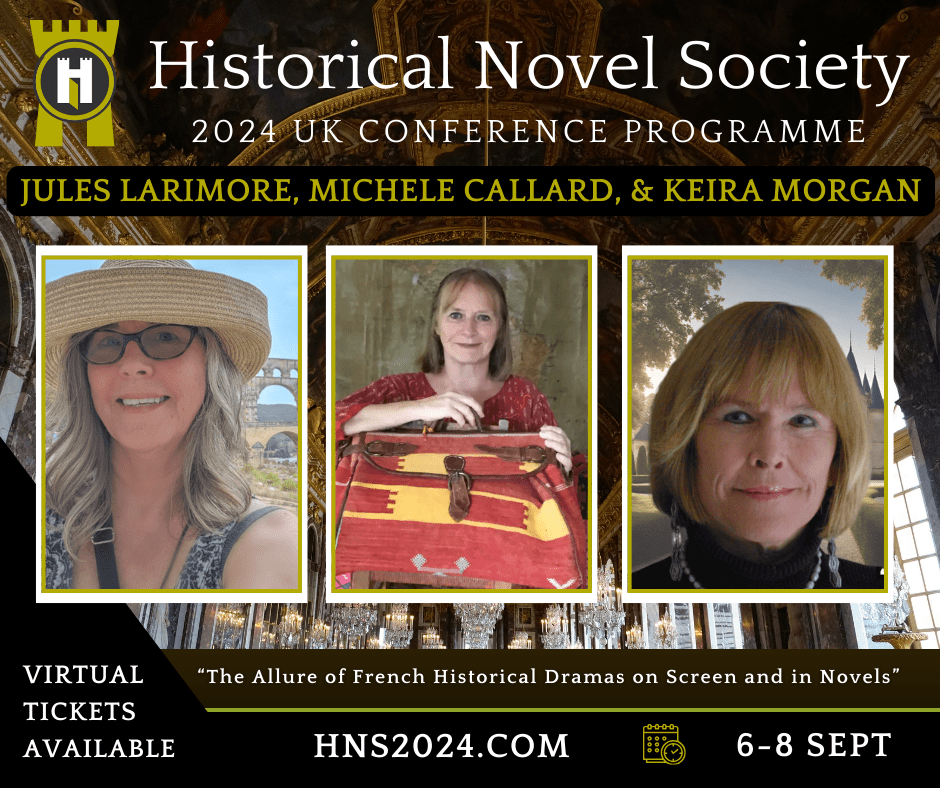
Michèle Callard is presenting “The Allure of French Historical Dramas on Screen and in Novels” at the HNS 2024 UK Conference, along with Jules Larimore and Keira Morgan
HNS has launched the First Chapters Competition with the conference. What is a novel you’ve read over your life that unexpectedly grabbed you from the opening lines and whose words stayed with you?
“Last night I dreamt I went to Manderley again.” What a book! Daphne du Maurier is my reference. I loved how, in Rebecca, you gradually realise things are not what they seem. Weirdly, I left the book under an LED light and left for a holiday. “Rebecca” caught fire and burned down half our house.
What would you say was the most influential writing advice you received from another author?
My reader asking me at the top of certain chapters, ‘What is your character’s goal in this chapter?’
Oh, and ‘kill your darlings.’ As a historian, editing has to be so ruthless, it’s a total bloodbath. Heart-breaking, really. All that lovely research down the plug hole.
Before he died, my friend and mentor, the author Mario Reading said to me, “free your writing,” and “read like a writer.” I’m still puzzling them out.
Of the wide cast of characters in your novels, who has been your most surprisingly challenging character to write?
The antagonist in the Sand Vines might become the protagonist in a later book of the saga. Everything he says has to be ambiguous, and he can’t be too bad.
What do you think it takes to have longevity across a writing career? Sanity? Fun? What’s an unexpected joy that came into your life from such a successful career?
My husband loves our research trips as my valet Passepartout. Researching a setting turns me into a beagle sniffing out a bone. The moment I find it is electric, I think, “Ha! That’s it! My book is done.” It can happen anywhere, in the Basque Country during a village meal, in the Cévennes at a soup festival, and in Nevada, visiting a ranch steeped in 1870 paraphernalia. Travelling for research multiplies the thrill by a factor of a thousand.
Another joy is being part of France’s Splendid Centuries. I’m the token French woman.
Where do you typically begin your research? Do you have a go-to resource?
Newspaper articles and memoirs offer the most authentic impression of time and place. I speak French and German. It makes it easier.
How do you organize your story details across your series? (Character details, scene research, story lines, etc.)
I don’t. I’m a pantser, but each book takes so long, the characters become part of me. I once went to a fortune teller. She just regurgitated the plot of the book I was working on.
Is there a specific scene that you’ve written over the years that you feel especially connected to?
Yes! In The Wolf’s Legacy, Armand and his friend Virgile meet again in Paris two years after the student uprising of May 68. They’re drinking cheap Préfontaine wine out of Duralex glasses and eating spaghetti with Gruyère, and, I don’t know, the dialogue just poured out of them. My translator loved it too! I’ve never seen anyone so excited. Maybe you have to be French.
As a historical writer, if you could walk through a specific time / scene / building which would you choose and why?
I’m a flaneuse. As I walk around London, I would love to see the Thames crammed with frigates, schooners, barges and coracles, burly sailors hopping from one to the other to reach their ship. The muddy banks a mess of cranes, ropes, chains, bales of wool, fishing nets. . . dockers sitting on crates. Above all that, the cries of sea gulls fighting for scraps, the clinking of the riggings, and the air thick with smells. All we have left are Uber Boats and gulls. So sad.
What three books do you feel are necessary for any book collection to feel complete? What additional one would you add for an author’s library?
These three non-fiction books are so exciting and informative, everyone should read them. Black Diamonds, about coal barons in Victorian times. Seven Ages of Paris. Everything you never knew you wanted to know about France. Last Call. About so much more than prohibition. Explains how American politics function. (Brrr…)

What is France’s Splendid Centuries? This French historical authors’ collaborative contributes articles to France’s Splendid Centuries Facebook page, a place to share our passion for French history previous to the 20th century and encourage followers to share their interest in French historical figures and places.
What can you share about what you are writing now? Or an upcoming release?
On 1 May, The Sand Vines will be launched. It is the first book of the Vine Saga set in France in 1870, the story of an aristocrat and a peasant girl who elope across France. It will be followed by the Tears of the Vine, in which our couple head for California with nothing but “de l’amour et de l’eau fraiche“, as we say. But will love and water be enough? Out in September.
What was the last great book that you read?
Both Rozsa Gaston’s Margaret of Austria and Keira Morgan’s Importance of Wives are truly exceptional. So is Jules Larimore’s Meet Me Under the Stars. It is a privilege to be part of France’s Splendid Centuries. To run a session with Keira and Jules at the end of the HNS conference is very exciting.
Online tickets for the conference are available:
https://historicalnovelsocietyuk.regfox.com/online
Rebekah Simmers is a member of the HNS UK 2024 conference organisation team. Find out about her novel, The King
 The Historical Novel Society UK 2024 conference
Leave a reply to Historical Novel Society 2024 UK Conference: Conference Interviews – Rebekah Simmers Cancel reply