
Rebekah Simmers has been interviewing writers who are presenting at the HNS 2024 UK Conference
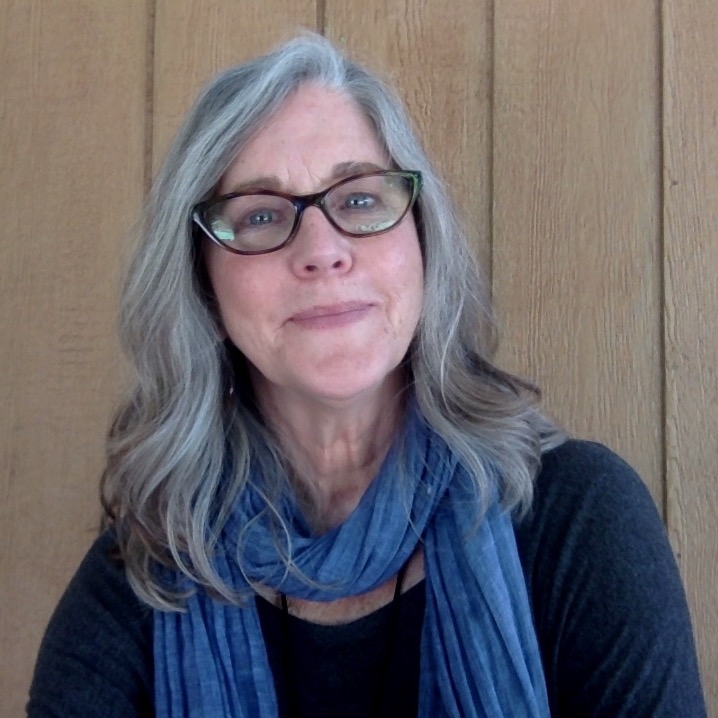
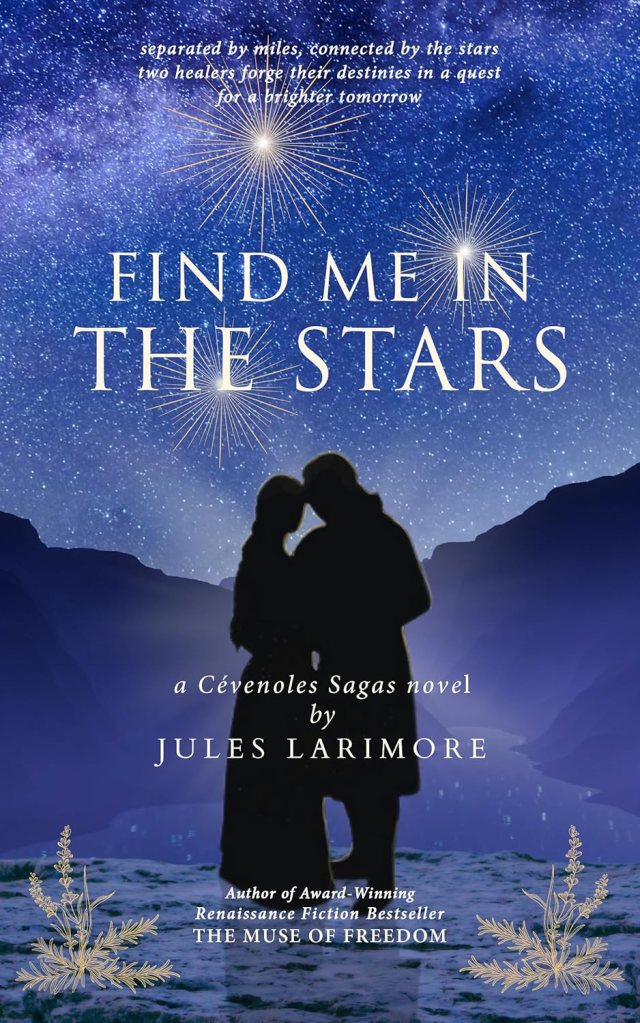
RS: We are so thrilled that you will be joining us for the HNS 2024 UK Conference! What are you looking forward to about the conference? Can you share a teaser for your presentation?
The exchange of ideas with fellow authors is something I’m eagerly looking forward to, as it brings about an increase in energy and inspiration for future writing projects.
Teaser – For many people in the U.K. and the U.S., France, and all things French, remain mysteriously attractive with a “je ne sais quoi” that represents an unattainable ideal. Historical dramas based on French history feed the desire to escape to a dazzling world where power, passion, and betrayal collide to create a gripping story. In this breakout session, we will explore this fascination—an enduring allure that bewitches readers and viewers alike.
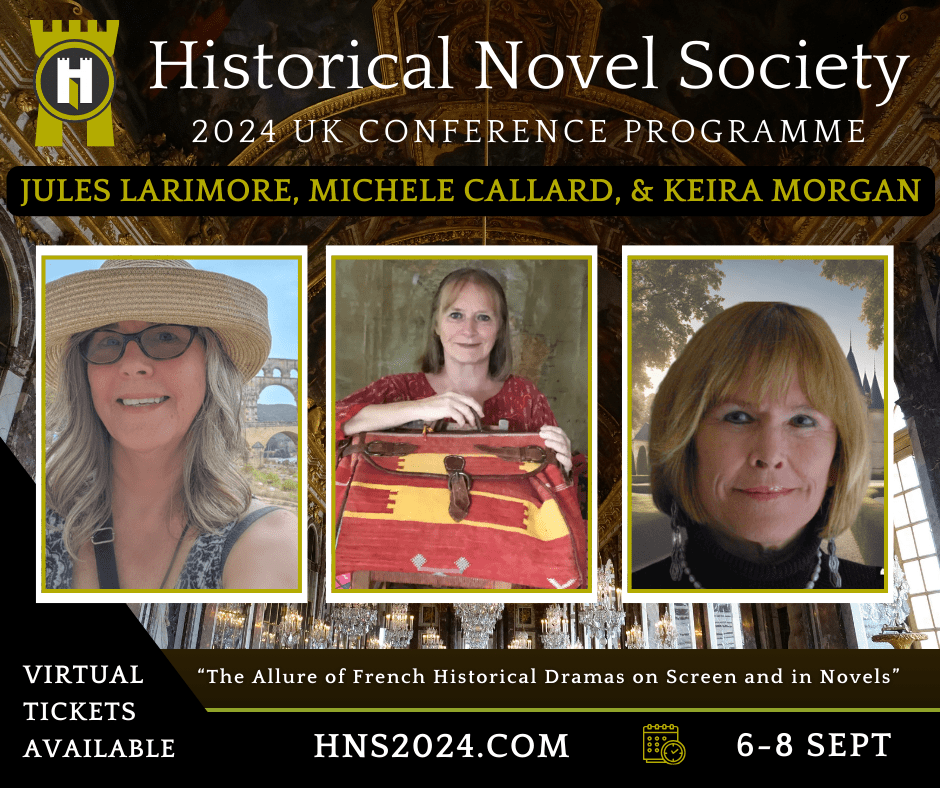
Jules Larimore is presenting “The Allure of French Historical Dramas on Screen and in Novels” at the HNS 2024 UK Conference, along with Michèle Callard and Keira Morgan
HNS has launched the First Chapters Competition with the conference. What is a novel you’ve read over your life that unexpectedly grabbed you from the opening lines and whose words stayed with you?
The Crimsom Chalice by Victor Canning, which I read as a young adult, transported me into the world of historical fiction for the first time. In this Arthurian tale, the opening lines paint the setting and create intrigue from an omniscient point-of-view, with a pack of dogs as the first characters introduced!
“As the sun tipped the eastern reaches of the forest and fired the pewter sea to silver at the far end of the valley, the May morning was full of song. Through the belling of tits, the monotonous sawing of the chiffchaffs and the melodious peeling of thrushes and blackbirds, Lerg, the big grey wolfhound, caught the clatter of a distantly falling stone on the valleyside path. Except for a slight lift of his muzzle from his crouched forepaws, he made no move; but his grey-flecked green eyes watched the turn of the path where it entered the wide glade.”
Looking back on your own writing career, what would you say was the most influential writing advice you received from another author? How have you made that work for you?
My favorite piece of advice that I’ve received is to read novels set in the same place and historical period. This helps me to settle into an era, and I often discover interesting, relevant details that aid in world-building. Useful sources are often listed in Bibliographies or Acknowledgement pages. Historical fiction authors deserve more credit for the extensive research they do!
Of the wide cast of characters in your novels, who has been your most surprisingly challenging character to write? Why? What strategies did you / do you use for these types of characters?
I would say my main protagonist, Jehan, in the Huguenot trilogy books, since he needed to have complex, rapidly evolving emotions. He had been forcibly held in a Dominican prieuré since the age of seven because of Louis XIV’s laws concerning children of Huguenot parents who refused to convert. I wanted to show a traumatized young man who, upon his release at the age of 18, is very naive. With his parents already passed, he is left to unravel the secrets they left behind. He believes his parents had abandoned him and his new world outside the prieuré is filled with divisiveness and persecutions. He doesn’t fit in with either the Catholics or the Protestants since he lives under the label of nouveau converti. I needed to show his struggles and challenges as he interacts in daily living until he finally unravels the secrets and finds the guidance he needs.
What do you think it takes to have longevity across a writing career? Sanity? Fun? What’s an unexpected joy that came into your life from such a successful career?
I’m sure what creates longevity is different for each author. For me it is writing only stories that I am fascinated by, sticking to a routine that incorporates health and wellness, and having a support circle of other historical fiction authors. I need each of those to keep putting one word in front of the other!
I never imagined that I would be spending more time in Europe because of my writing career, but I am thrilled that it is happening. As if the joy of presenting at this conference were not enough, while researching ancestors I discovered I descend from the Courtenay line, owners of Powderham Castle, one of the excursions at the conference. Also in September, I have the pleasure of leading a readers group to sites in my novels in southern France. While on the subject of southern France, I also get great joy from the many locals and expats in the region who are interested in my books and have invited me to do author talks.
Where do you typically begin your research? Do you have a go-to resource? Has there been anything that you’ve researched for your writing over the years that made a huge impact on you or a novel or series that you were writing? That changed how you write or what you write?
I have no one go-to source, but location is my first stop. It’s important to me to embody the setting and culture first, to experience a place through its flora and fauna, geology and architecture, and to hear the voices of the people who lived during the era I am writing about, even before I do much other research.

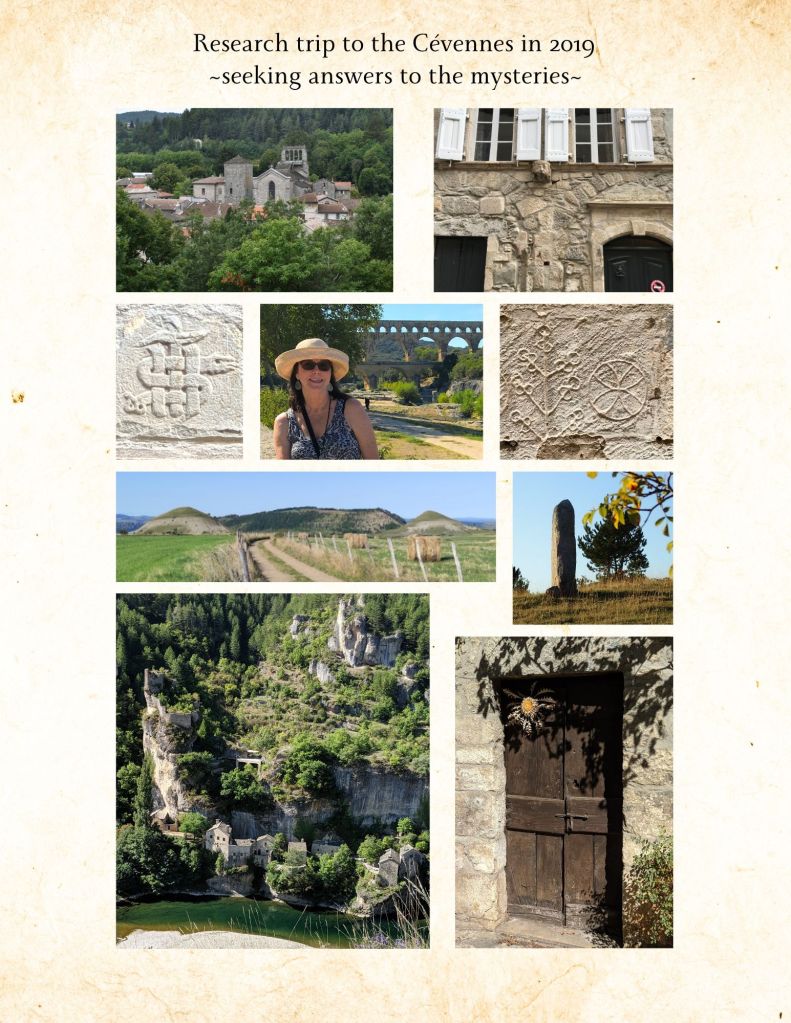
Since I write French historical fiction, but I’m not fluent in French, beginning with primary sources for research is impractical. So I look to scholarly publications or bibliographies with well-cited primary sources to start. I also use online archives to provide primary and secondary sources, memoirs, pharmacopeias, and manuscript collections. Other great resources are museums, historical associations, genealogy websites, old map websites, and historical guides such as Ian Mortimer’s Time Traveler’s Guide series or Dale Taylor’s Everyday Life in Colonial America.
While researching on “Geneanet” in search of more information on the Bondurant family, I came across the genealogy of a distant cousin in Paris. He had found documents in the regional archives revealing Jean Pierre Bondurant’s (the inspiration for the male protagonist in the Huguenot trilogy) father, Sieur Bondurant de Cougoussac, had been imprisoned in the Tour de Roi (King’s Tower) dungeon in Uzès, France, for a month. Sieur Bondurant, a nobleman with an estate, was arrested for his refusal to pay the king’s newly imposed taxes, despite having the financial means to do so. It must have been his way of protesting the king’s many new measures meant to stifle the nobles, especially Huguenot nobles. Finally, Sieur Bondurant’s wife hired a lawyer and paid the fine for his release. This bit of information gave me more insight into the sort of man Jean Pierre’s father was.
How do you organize your story details across your series? (Character details, scene research, story lines, etc.)
This is an ever-evolving process. I’ve tried a few online programs hoping to make it more cohesive, but often end up back with Google docs. I have a timeline of factual events and information that is the backbone of my research, and another outline of notes covering things like politics, economy and trades, religion, society, medicine, clothing, transportation, and intellectual and artistic developments. I create a separate document with character profiles and use Pinterest as a visual guide for all of these topics. I have a hybrid plot line template that was assembled from those ideas from other authors.

Is there a specific scene that you’ve written over the years that you feel especially connected to? If not a specific scene, a secondary story line that was a favorite to write?
Not that it is my favorite scene, but I feel most connected to the death scene of my female protagonist’s grandmother. It’s one of the more challenging scenes I’ve written because, like an actor, I tapped into my own emotional experience. I used elements of my mother’s passing to create feelings and reactions for both my protagonist and her grandmother.
As a historical writer, if you could stand witness to a historical event or walk through a specific time / scene / building or have a frank discussion with one historical figure, which would you choose and why?
I have a work-in-progress about Adelaide de Toulouse, Comtesse of Burlats and Carcassonne, set in the second half of the 12th c. in Occitania. She was proclaimed to host the most wonderful “courts of love” with renowned troubadours. I would like to attend one of her gatherings and ask her how she remained joyful and magnanimous despite having a husband, Roger Trencavel, who neglected her.
What three books do you feel are necessary for any book collection to feel complete? What additional one would you add for an author’s library?
I can only speak for which three books would make my book collection feel complete since I am not trained in the classics, and those would all be fiction. Instead of Shakespeare, Chaucer’s Canterbury Tales; Steinbeck’s The Grapes of Wrath; Fitzgerald’s The Great Gatsby. I have to throw in a fourth that is actually one of the most important books of our time—The Little Prince by Antoine de Saint-Exupéry because “It is only with the heart that one can see rightly: what is essential is invisible to the eye.”
One non-fiction book I don’t have but would like is, Steering the Craft by Ursula Le Guin, intended for experienced writers, the ones, she says, who “blow all Rules of Writing to bits.” That would be me!
What can you share about what you are writing now?
I am working on both a new series about Capetian women in the 12th and 13th centuries as well as starting research for the third book in my Huguenot trilogy.

What is France’s Splendid Centuries? This French historical authors’ collaborative contributes articles to France’s Splendid Centuries Facebook page, a place to share our passion for French history previous to the 20th century and encourage followers to share their interest in French historical figures and places.
What was the last great book that you read? (Can simply be author and title)
The last great novels I read are all from the authors in the France’s Splendid Centuries writers collaborative. I am thrilled to be part of a group of such talented writers whose works deserve attention. I recently completed Rozsa Gaston’s Anne of Austria and Keira Morgan’s The Importance of Wives, and I am really excited to dive into Michele Callard’s latest, The Sand Vines after enjoying her book The Wolf’s Legacy. A shout out also must go to Elizabeth Chadwick for Summer Queen.
Online tickets for the conference are available:
https://historicalnovelsocietyuk.regfox.com/online
Rebekah Simmers is a member of the HNS UK 2024 conference organisation team. Find out about her novel, The King’s Sword, on her website.
 The Historical Novel Society UK 2024 conference
Leave a reply to Historical Novel Society 2024 UK Conference: Conference Interviews – Rebekah Simmers Cancel reply