
Rebekah Simmers has been interviewing writers who are presenting at the HNS 2024 UK Conference
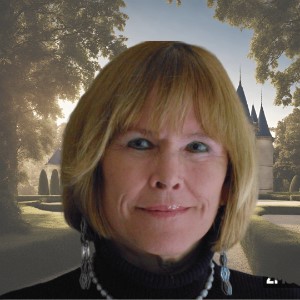
RS: We are so thrilled that you will be joining us for the HNS 2024 UK Conference! What are you looking forward to about the conference? Can you share a teaser for your presentation?
KM: So many things! Meeting and listening to so many authors I’ve read and admired from a distance. Meeting and presenting with my friends from our France’s Splendid Centuries collaborative. Being at beautiful Dartington. Visiting England for the first time in years. I won’t go on.
We are three presenters each of a different nationality so each of us brings a different perspective to our subject. And we have original survey results to present. Teaser – For many people in the U.K. and the U.S., France, and all things French, remain mysteriously attractive with a “je ne sais quoi” that represents an unattainable ideal. Historical dramas based on French history feed the desire to escape to a dazzling world where power, passion, and betrayal collide to create a gripping story. In this breakout session, we will explore this fascination—an enduring allure that bewitches readers and viewers alike.
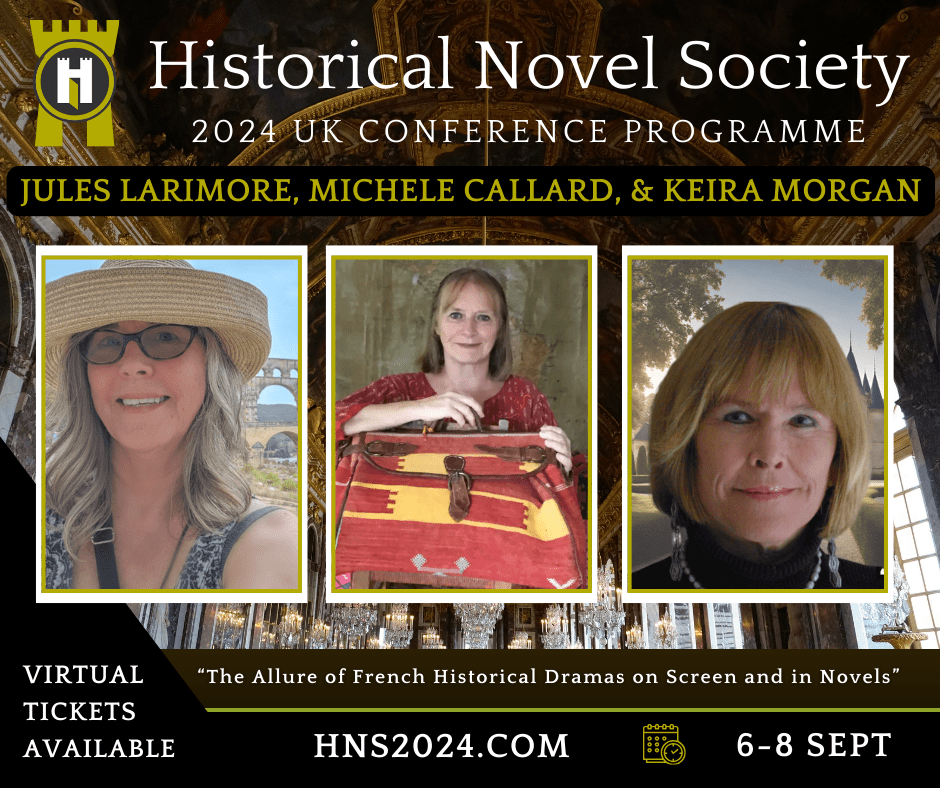
Keira Morgan is presenting “The Allure of French Historical Dramas on Screen and in Novels” at the HNS 2024 UK Conference, along with Jules Larimore and Michèle Callard
HNS has launched the First Chapters Competition with the conference. Openings are so important – what advice would you give about crafting a first chapter?
The first chapter must set out the stakes that my main character must overcome and the higher they are the better. That first chapter is such a challenge anyway because it must do so much work: catch our readers’ attention, draw them in, give them enough context that the story makes sense from the get-go, touch their hearts, introduce the main characters, and develop meaningful conflict. On top of all that, we must persuade our readers the central problem is as close to a life and death issue for our protagonist as possible so they will feel it is worth their time to read it.
Of the wide cast of characters in your novels, who has been your most surprisingly challenging character to write?
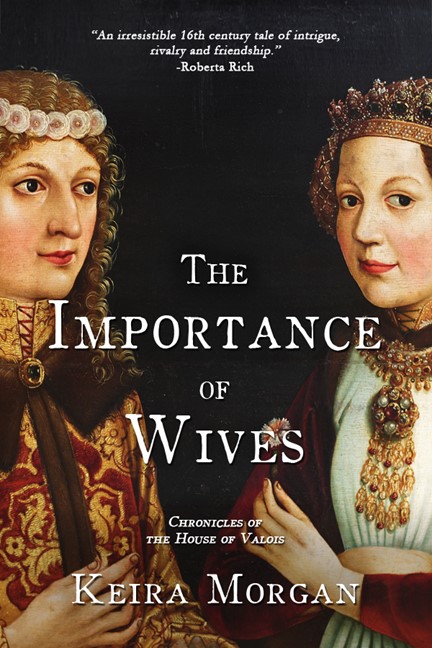
The characters I dislike are the characters I find hardest to write because I find it hard to see anything positive in them, but it makes them one dimensional. Few people are truly evil, and Anne’s enemies are against her because they want different outcomes than she does or so I tell myself. But Anne was a black and white person herself. In The Importance of Wives, once Marshal de Rieux and Mme de Dinan turned against her, I had most trouble with them. To deal with it I put them in situations where they showed a different side of their character when they were dealing with characters they liked or were their equals or allies.
What do you think it takes to have longevity across a writing career? Sanity? Fun? What’s an unexpected joy that came into your life from such a successful career?
Good question. Perhaps the most important part is liking both the research and the writing. Not every day and every minute of course; that wouldn’t be human. But if you are fascinated by your period, then learning about it intrigues you. Also, if you like either the writing or the rewriting and learning about what makes good writing, you want to stick with it. Perhaps you must be happy spending lots of time alone.
The most unexpected pleasure has been collaborating with other writers of our “France’s Splendid Centuries” group to create and continue our Facebook page. Now I have friends who share the passion for writing historical fiction about France.
Where do you typically begin your research? Do you have a go-to resource?
I studied Renaissance and Reformation history at university and have continued to read everything I find ever since so I have a deep background in the subject. Now, because I live in Mexico, I rely heavily on internet resources. In fact, the internet has changed everything about how I research. Fortunately, France is advanced in its digitization of much of its historical material. Gallica, their national on-line digital library is the first place I go, but there are also many more. I can’t even begin to list them all. The one’s I use most often I link to my website so I can return to them easily.
How do you organize your story details across your series? (Character details, scene research, story lines, etc.)
Because my books so far have been extremely historically based, I have been keeping spreadsheets on which I keep track of what my main historical characters were doing by year. This has been quite useful at a macro level.
I also keep a large file on my computer of images of paintings of my characters and the locations of where they lived, both interiors and exteriors. I am fortunate that many of these places are well preserved so that I can find these images and most of them are in the public domain on wikicommons.org. Another wonderful source for images is Google earth where I can zoom in to get a bird’s eye view of the locations.
I am very much a plotter, my books do keep to the historical timeline, and my main characters are real historical people so sticking to a consistent story line is not a problem. However, for the details it is hard to be as perfectly consistent as I would like, especially since I didn’t write my books in chronological order—but that is another story. So once I have finished I have set myself the goal of going back and fixing the errors I know I have made. Sigh.
As a historical writer, if you could stand witness to a historical event or walk through a specific time / scene / building or have a frank discussion with one historical figure, which would you choose and why?
Since I am still writing my series, the person I would most love to meet is King Louis XII. He participated in all the major events I write about and could give a first-hand account of what really went on. I have a lot of unanswered questions. When he became king of France, he apparently reassured those whom he had warred against that, “the King of France does not redress the injuries of the Duke d’Orléans” (his previous title). I would love to know his opinions of the key players in the game, such as Pope Julius II, King Charles VIII, Duke Francois II of Brittany, Countess Louise d’Angoulême and Duchess Anne de Beaujeu, not to mention Anne of Brittany herself.
Louis was popular with his people because he was financially prudent and kept taxes down. He also began the consolidation of the many different laws and tax systems in France. So, I want to know why he was so determined to conquer Milan for France even though it was across the Alps, yet so sensible about France’s land borders otherwise.
In a self-serving way, I want to know what happened when he decided to break the betrothal of Count Charles of Flanders (later Emperor Charles V) and their daughter Claude and instead betrothed her to François d’Angoulême, his heir. We know Anne was furious and that it caused a rift with Emperor Maximilian, whom Anne had jilted many years previously. I would love the inside scoop on all the details for my next book.
What three books do you feel are necessary for any book collection to feel complete? What additional one would you add for an author’s library?
I cannot imagine how a writer could function without access to an excellent dictionary, thesaurus, and an encyclopedia of historical biography for his, her or their era. Now these resources don’t have to be physical, they can be electronic but to me they are essential. I would add an historical geography, dictionaries of language for their era, bilingual dictionaries, and on-line translators if they work in more than one language, as I do.
(As an aside, I do not think that on-line translators are adequate–knowing the language is important–but sometimes they help when you aren’t certain you have understood, especially when reading older documents.)

What is France’s Splendid Centuries? This French historical authors’ collaborative contributes articles to France’s Splendid Centuries Facebook page, a place to share our passion for French history previous to the 20th century and encourage followers to share their interest in French historical figures and places.
What can you share about what you are writing now? Or an upcoming release?
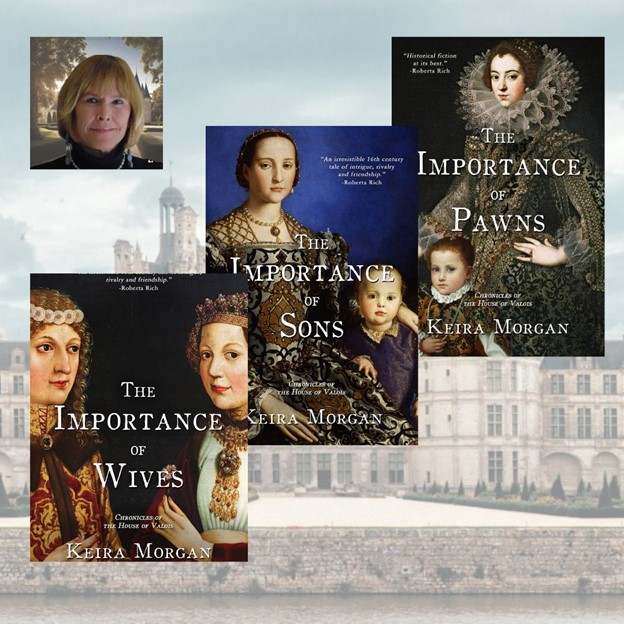
I am writing the fourth and last book in my Anne of Brittany series. It comes third in the sequence and tells the story of the ups and downs in Anne and Louis XII’s marriage as Anne continues her life mission to keep Brittany independent of France.
What was the last great book that you read?
A Gentleman in Moscow by Amor Towles.
Online tickets for the conference are available:
https://historicalnovelsocietyuk.regfox.com/online
Rebekah Simmers is a member of the HNS UK 2024 conference organisation team. Find out about her novel, The King
 The Historical Novel Society UK 2024 conference
Leave a comment