
Rebekah Simmers has been interviewing writers who are presenting at the HNS 2024 UK Conference


RS: We are so thrilled that you will be joining us for the HNS 2024 UK Conference! What are you looking forward to about the conference? Can you share a teaser for your presentation?
EC: I am delighted to be attending the HNS 2024 Conference. I am so looking forward to learning news and learning from others writing in the historical fiction genre, and to meeting many good friends and colleagues that I have only ever met online before. Talking shop with like-minded people of a wonderful genre is going to be so energising. Our presentation, Writing Medieval, is going to be great fun and very interesting to see how different authors tackle thorny issues, such as creating authenticity when building their characters and their worlds. Is there a consensus? I don’t yet know!
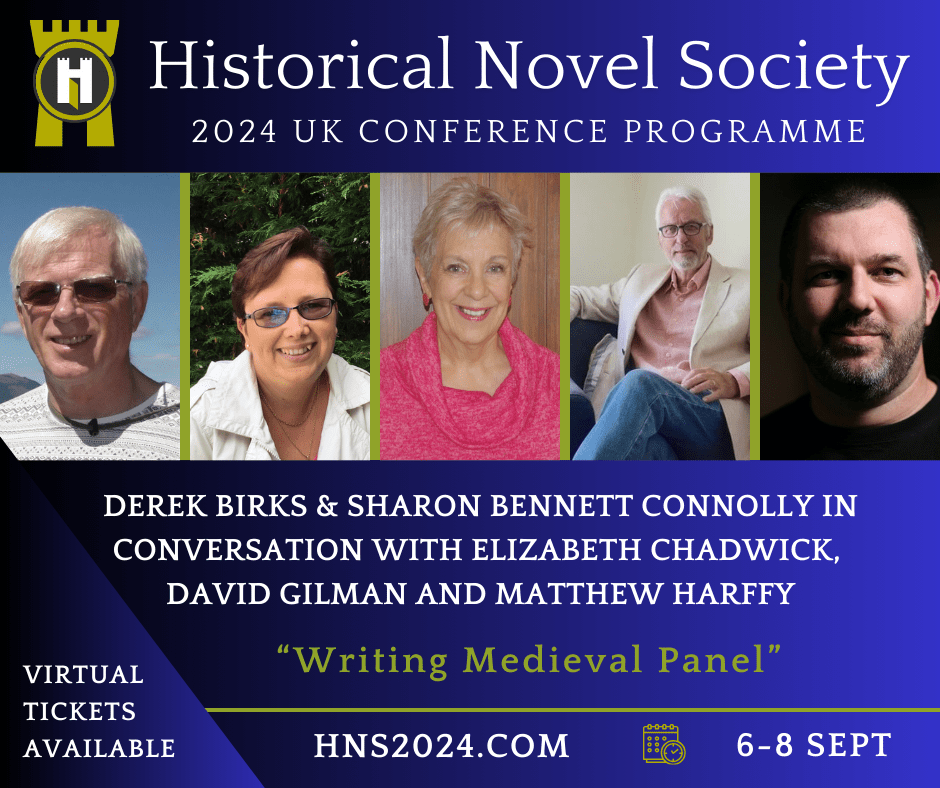
Elizabeth Chadwick will be in conversation with David Gilman, Matthew Harffy, Derek Birks & Sharon Bennett Connolly on the “Writing Medieval Panel” at the HNS 2024 UK Conference
HNS has launched the First Chapters Competition with the conference. What is a novel you’ve read over your life that unexpectedly grabbed you from the opening lines and whose words stayed with you?
After a lifetime of reading so many wonderful books, you have put me on the spot! I think I would have to say The Game of Kings by Dorothy Dunnett. Dunnett’s use of language, world building and plotting are simply in another league. As a reader I am always enthralled. As a writer she inspires and uplifts me. There is no one quite like Dunnett.
From following you on SM, you frequently offer (much appreciated – I’ve enjoyed following you for years and especially appreciate the research books you showcase!) valuable and varied writing advice in your posts. Looking back on your own writing career, what would you say was the most influential writing advice you received from another author? How have you made that work for you?
I don’t think I’ve ever received any from anyone else. My learning curve has always been through reading and assimilating for myself. I have learned from my editors and my agent and from experience. In my early years I was guilty of head-hopping and of using medieval terminology that many would appreciate but others would not understand. These days, although I still use the terminology, I’m more judicious and try to make the meaning clearer to readers, and all head hopping is absolutely intentional! I have learned that everything boils down to guidelines, not rules. I learned a lot from my dear friend Sharon Kay Penman. Not so much about actual writing, but about the ability to sail smoothly on troubled waters and sit on one’s hands, even if desperately needing to respond to an issue. To know when the game wasn’t worth the candle. She and I often discussed such moments in private, but didn’t take the lid off in public!
Of the wide cast of characters in your novels, who has been your most surprisingly challenging character to write? Why? What strategies did you / do you use for these types of characters?
Not so much surprising, as bucking the trend of popular history. It would be William Marshal’s father John from my novel A Place Beyond Courage. The story goes that John had to give his five-year-old son, the future famous William Marshal, as a hostage for his word of honour. When John went back on his promise, William’s life was forfeit and when told that his son was going to hang, John is supposed to have said, ‘Go ahead and do so, for I have the anvils and hammers to get better sons than him.’ When I came to write the novel, I wanted to explore the man behind the story and see what led to him saying such a thing. Was he a monster? Was he just trying to survive and taking the loss for the good of the many? I had to dig very deep and think out of the box to come up with the answers, but they turned the popular tale right on its head. I even wrote an essay on the subject and submitted it to the Royal Historical Society as part of my membership application. I guess it was my ‘Richard III’ moment – i.e. rehabilitating a reputation by questioning the popularly perceived history which turned out to be way off the mark.
What do you think it takes to have longevity across a writing career? Sanity? Fun? What’s an unexpected joy that came into your life from such a successful career?
Stamina, perseverance, a love of writing, a love of history and an intense curiosity about everything. Stay bright, stay inquisitive and give it your best shot. A sense of humour, especially of the ridiculous helps a lot. I have two sources of joy. The first is the fabulous reader and writer friendships I have made on social media. The second is the opportunities being a writer of historical fiction have afforded me. A private guided tour of Westminster for example, seeing all the places where the tourists don’t go – courtesy of one of the parliamentary ushers who had read one of novels and then written to invite me. Going on tour with readers and discovering the life of William Marshal in Ireland; taking a balloon ride along the Wye Valley and seeing historical monuments from the air. Being handed an award cheque by Prince – now King Charles.
Where do you typically begin your research? Do you have a go-to resource? Has there been anything that you’ve researched for your writing over the years that made a huge impact on you or a novel or series that you were writing? That changed how you write or what you write?
Once I have decided on my subject, I jointly trawl online and find the books, the articles, the theses, the information I need to understand my subject matter. I don’t have any one go to resource. I do have an extensive home library of reference works on a wide variety of subjects. A historical novelist has to be a jack of all trades and know all manner of things about the world they are creating in which their characters move. It doesn’t all have to go into the novel, but it’s there as background support. It’s a visceral, sensual experience, and to get there, the writer needs the knowledge. I have re-enacted in the past when I have had the time, and this has given me a good grounding in some of the ‘feel’ side and the practical side with such things as wearing the clothes and using implements. The biggest impact and most controversial is my use of the psychic side to get at my characters and their lives. That has greatly enhanced my conventional research. It helps me think outside the box and, for me, is a brilliant resource when checked against the usual academic research resources.

How do you organize your story details across your series?
It’s all in my head. I may be unusual that way, but it’s how it is and always has been. Imagine that my mind is like a large container or deep well with multi-coloured Velcro stripes. I throw in all my stuff, colour-coded and it sticks to the sides and in the right order. Sometimes I need to work on a scene from a research book, or there’s a quote to be incorporated, and in that case, I’ll have coloured stickers in the particular book. I’ll know which book it is by referencing back to the Velcro well. When I start work on a novel, I separate out from my master library the books I am going to need to write it and put them on their own shelf near my desk.
Is there a specific scene that you’ve written over the years that you feel especially connected to? If not a specific scene, a secondary story line that was a favorite to write?
Not as such. There are always meaty scenes that I know I am going to get stuck into and that I look forward to crafting. Dramatic, emotionally deep scenes are always a favourite. I often have readers tell me that I have made them cry – very often men! One told me that ‘it’s not nice to make a grown man cry on a train’ as he read on the way to work. Another said he was reading a novel on holiday and had to wait until his wife was asleep because he didn’t want to sob in front of her. I don’t cry when writing those scenes, but if I get those moments right, then there’s enormous satisfaction in knowing I have done my job. Not just weepy scenes, I hasten to add, but anything with a big emotional resonance. To me it’s about making the reader feel.
As a historical writer, if you could stand witness to a historical event or walk through a specific time / scene / building or have a frank discussion with one historical figure, which would you choose and why?
I would love to go to a medieval tournament with the great William Marshal and experience it for myself – right from dawn of the day to the evening parties and with a backstage pass to access all areas!
What three books do you feel are necessary for any book collection to feel complete? What additional one would you add for an author’s library?
I don’t feel that ANY book is absolutely necessary because we are all very different readers. For example, someone might say that Austen or Dickens are essential and I’d just say ‘Blah.’ The books of your heart are the ones that should be there, and they will be individual to you. You will want to re-read them. You will find something new every time you read them. They will feed your soul. But I’m not going to tell anyone that a specific book is ‘necessary’. I’d fiercely rebel against it.
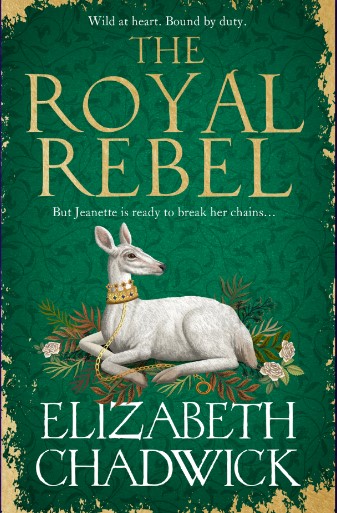
What can you share about what you are writing now? Or an upcoming release?
The Royal Rebel is about to be published and I am writing an untitled follow up, being part two of the life of Joan of Kent, mother of Richard II. I’ve finished the very rough drafts and am now working it into a presentable shape.
What was the last great book that you read?
In historical fiction, I loved the recently published Costanza by Rachel Blackmore. In non-historical fiction, it would have to be Fairytale by Stephen King.
Online tickets for the conference are available:
https://historicalnovelsocietyuk.regfox.com/online
Rebekah Simmers is a member of the HNS UK 2024 conference organisation team. Find out about her novel, The King’s Sword, on her website.
 The Historical Novel Society UK 2024 conference
Leave a comment