
Rebekah Simmers has been interviewing writers who are presenting at the HNS 2024 UK Conference


RS: We are so thrilled that you will be joining us for the HNS 2024 UK Conference! What are you looking forward to about the conference? Can you share a teaser for your presentation?
DG: This will be my first conference so I’m looking forward to having the opportunity of sharing a Q/A panel on the first day with some wonderful authors. I’m hoping the audience will be sufficiently enthused and fire off plenty of questions.
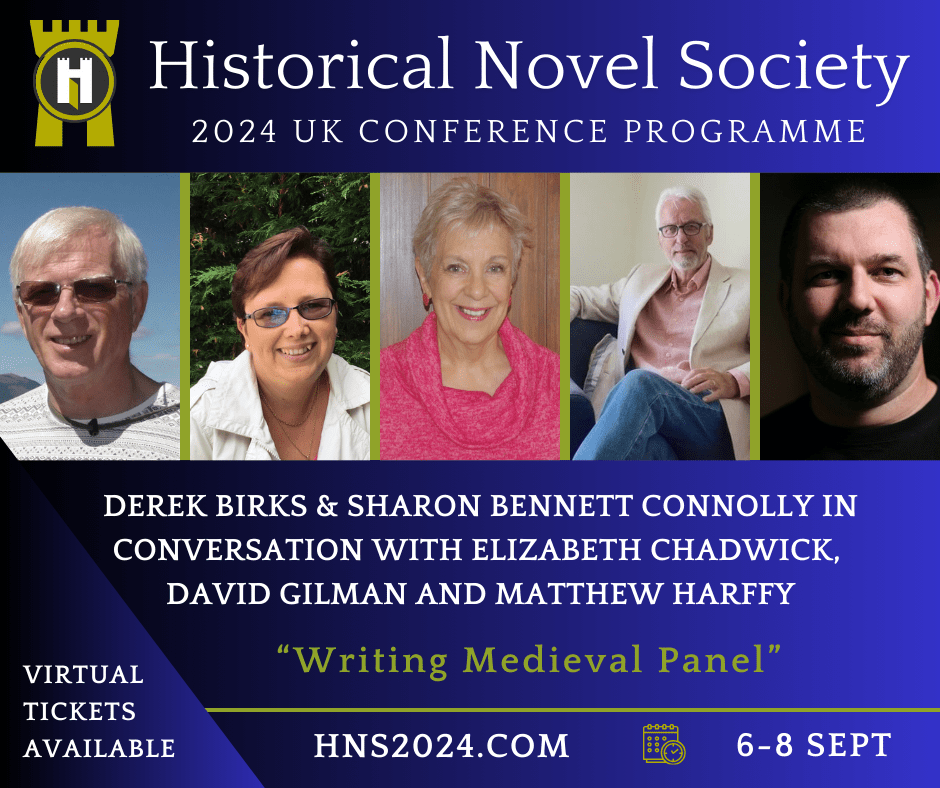
David Gilman is participating in the “Writing Medieval Panel” with Elizabeth Chadwick and Matthew Harffy, in conversation with Derek Birks and Sharon Bennett Connolly
HNS has launched the First Chapters Competition with the conference. What is a novel you’ve read over your life that unexpectedly grabbed you from the opening lines and whose words stayed with you?
Let me cheat here. Child of the Ruins by Kate Furnivall – recently published – has a viscerally powerful opening chapter. Very powerful.
Beyond that my memory is less to do with opening lines and more about an image I have from one particular book from the early 1950s. It’s only a snapshot from one of many books that followed. I grew up in a household where there were very few books. I had the usual wonderful adventure stories when I was very young, Treasure Island, The Count of Monte Cristo, books I couldn’t get enough of. Beyond those my father, when he had any time, read commercial authors like Leon Uris. I must have been about nine years old when I picked up his novel about the US Marines, Battle Cry. It was a novel of hard-fought battles, sacrifice and heroism. To this day, I remember some of the characters. Colonel Huxley was ‘Highpockets’ because of his height, and also ‘Captain Shapiro’. These names stay embedded in my memory. It was a story well told that created memorable characters you don’t forget. Something all authors hope to achieve.
Looking back on your own writing career, what would you say was the most influential writing advice you received from another author? How have you made that work for you?
When I first started writing for television, an accomplished writer at the time advised me never to write anything that required research. That it took up too much time. I’m pleased to say I ignored that advice.
Of the wide cast of characters in your novels, who has been your most surprisingly challenging character to write? Why? What strategies did you / do you use for these types of characters?
There’s a complexity and conflict within characters in a novel. As well as contradiction. Characters tend to unfold throughout the story. Their own instinct drives them, as well as their background. I hope my characters offer an emotional hinterland that is expressed through their actions and thoughts. As an example, for my main character Thomas Blackstone, when he starts in Master of War as a 16-year-old, he was responsible for protecting his younger brother. His intelligence and courage saved them from being hanged in the first book. These instincts are part and parcel of who he is – and yet he is an exponent of war who inflicts relentless violence on his enemies.
What do you think it takes to have longevity across a writing career? Sanity? Fun? What’s an unexpected joy that came into your life from such a successful career?
Stamina. I find it’s a never-ending challenge. But it’s our job to get on with it and write the book. Research is a pleasure. Poring over books and documents, which is often enhanced by travelling whenever possible to the locations I use in my books.
How do you organize your story details across your series?
Any book will start with a reason for my characters to be where they are. As a HF author the big events in history often generate such a reason but it’s the story that embellishes those events in history. I turn to my characters to lead the way. If I am writing a series, I know the main characters very well and when someone new appears (sometimes unexpectedly) I look at what motivation has brought them into my story. My writing is full of surprises – and then the challenge to solve the problems these characters bring.
Is there a specific scene that you’ve written over the years that you feel especially connected to? If not a specific scene, a secondary story line that was a favorite to write?
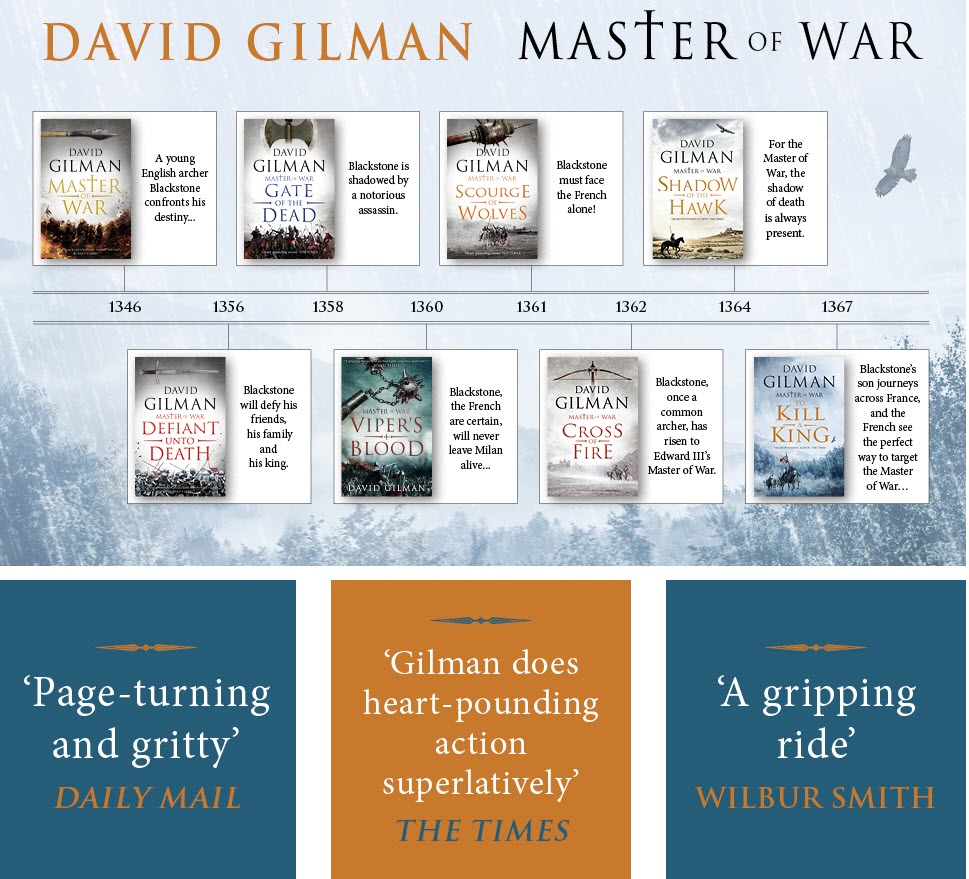
In my standalone WW11 novel, Night Flight to Paris, I brought together a diverse group of characters but there were two scenes – very short – barely a sentence or two – that expressed the poignancy of war. A village boy was killed by making a wrong move, and the ageing local policeman stoically stood his ground against a group of SS. A secondary storyline that I felt was very strong was in my Master of War series when Thomas Blackstone’s wife and child were murdered.
What three books do you feel are necessary for any book collection to feel complete? What additional one would you add for an author’s library?
There are so many excellent books written that I find it hard to choose any three. I have managed to get together a small but effective library for my own work. Jonathan Sumption’s series of books on the 100 Years War is monumental. There are five books in the series. An amazing accomplishment.
What can you share about what you are writing now? Or an upcoming release?
I have the paperback edition of To Kill A King being published this September. It’s the eighth book in the Master of War series.
Last year I wrote a standalone HF novel, which is in the editing process and will be published in early 2025. It’s set in the early 17th century. It begins in Totnes, Devon, a town I lived in for nearly 30 years, a place rich in history, which I hope some of the visitors to the conference might have time to explore. My novel, The Knife Maker’s Apprentice, is about a young blacksmith, Richard Sherrif and his sister, Elizabeth, captured by Barbary Pirates in 1603, transported to the Tunisian slave market and, from there, taken to Venice. Their lives take on major changes as Venetian society exposes them to an elaborate and luxurious way of life and the cruel and dangerous undercurrent that flows through it.
What was the last great book that you read?
My fiction reading is running behind given the amount of research I do. It’s unfair to nominate just one book but I will go back a few years to Carlos Ruiz Zafón – The Shadow of the Wind.
Online tickets for the conference are available:
https://historicalnovelsocietyuk.regfox.com/online
Rebekah Simmers is a member of the HNS UK 2024 conference organisation team. Find out about her novel, The King’s Sword, on her website.
 The Historical Novel Society UK 2024 conference
Leave a reply to Historical Novel Society 2024 UK Conference: Conference Interviews – Rebekah Simmers Cancel reply