
Rebekah Simmers has been interviewing writers who are presenting at the HNS 2024 UK Conference
Behind the Scenes of Historical Novel Society 2024 UK Conference with Conference Lead Organizer, Tracey Warr
Details, Details, Details; Links and More Links; Advice and Reflections
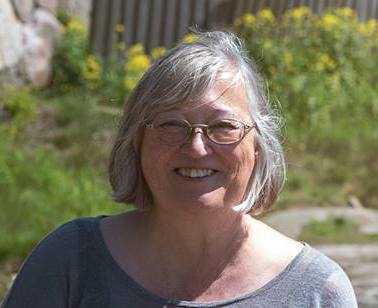

Conference guru? Organiser? Tracey – what would you call your position for the conference? I always call you the wizard, lol!
My grandson would enjoy the wizard label for me!
I am the conference lead organiser and working with a great team, including you, Richard Lee, Katherine Mezzacappa and others.
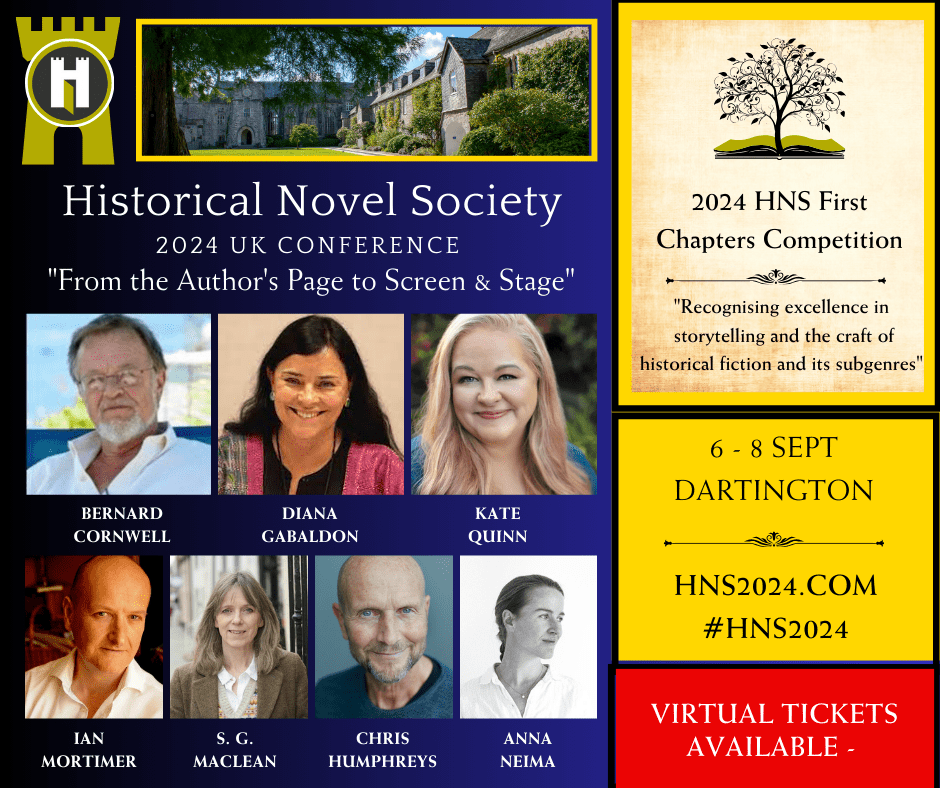
Where to Information –
- Website
- IG
- X
- #HNS2024 #HNS2024UKConference
- Email info@hns2024.com
First things first – are there any tickets left? ONSITE? VIRTUAL?
Yes! After some last minute cancellations, there are a few onsite tickets left. You can book those here. Virtual tickets are on sale until Friday September 6, 2024 12 noon (BST) and can be booked here.
How long have you been writing? What brought you to historical fiction?
I started writing fiction when my daughter grew up and left up home – about 27 years ago. I was living in southern France at the time, surrounded by fabulous castles and medieval villages and got hooked on researching the history around me and especially the history of little-known early medieval women who I found in the chronicles of the time.
When did you first join the Historical Novel Society / HNS? Have you attended their conferences previously?
I think I joined around 2011, when I published my first novel, Almodis: The Peaceweaver. I’ve been to several UK conferences, including London in 2014, Oxford in 2016, Durham in 2022. I also attended the HNS North America 2021 virtual conference and some of the HNS Australasia conference masterclasses.
How do you think attending writing conferences has helped you as a writer?
A lot of the time, I feel a bit of an oddity as a historical fiction writer, especially since most of my career was spent working with contemporary art. I often have to defend my choice to write about the medieval period. At these conferences, I’m surrounded by like-minded people. I am inspired by the talks and workshops, by listening to other writers’ stories and tips.

What inspired you to sign up to run the HNS 2024 UK Conference? What led you to hosting the conference at Dartington?
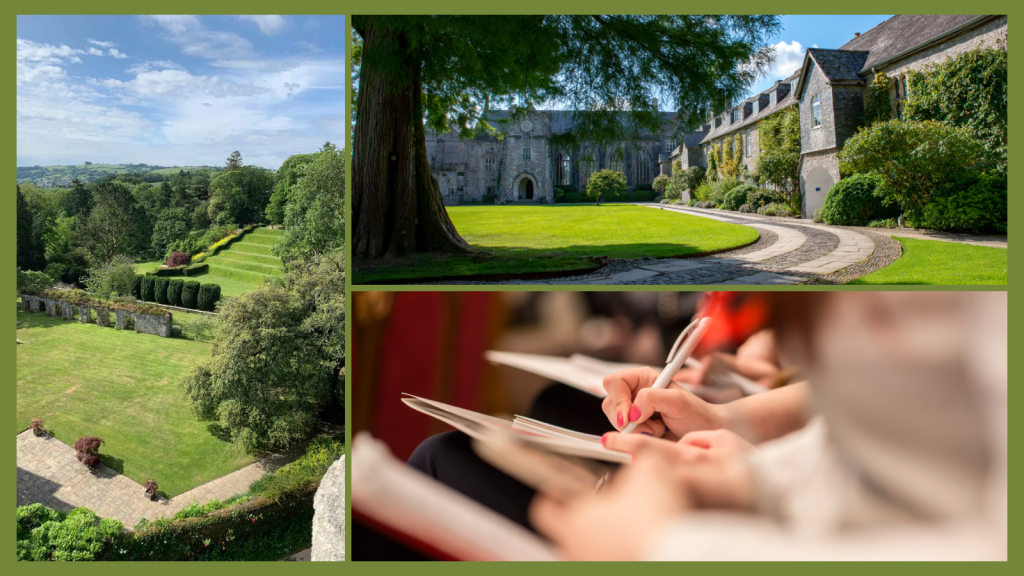
I worked and lived on the Dartington estate for nine years so I knew it was a venue with its own fascinating medieval and modernist history and that it would lend itself well to an HNS conference. Richard Lee, the HNS founder, also lives nearby and knows the site – so it seemed an obvious contender.
Now that you have a “Behind the Scenes” view, what would you say are the major challenges for being involved in the organisation of a conference? The major rewards?
The conferences – like everything else with the HNS – are run on a volunteer basis. I’ve organised conferences before and have run large-scale exhibitions and academic programmes, so I had a lot of the necessary experience and skills. Nevertheless, the major challenge is that it has been a lot more work than I anticipated. The conference has sold out to 250 people onsite and another 250 online – and many delegates are coming from overseas. Getting to grips with the technology – the registration platform (RegFox) and other tools we’ve used, such as WordPress, Wufoo, Mailchimp, Zoom Webinar – has been a steep learning curve. The other conference organisers had invaluable advice to give me at the start (thank you Margaret Skea, Aidan Morrissey, Jenny Quinlan, Jenny Barden, Alison Morton, Elizabeth Storrs). I held regular team meetings with yourself, Katherine and Richard for valuable input.
The major rewards have been getting to know more members of the HNS community and the learning I’ve had to engage in.
The HNS 2024 UK conference theme – “From the Author’s Page to Screen & Stage” – can you share a bit about it?
It was your idea! I can share that! We’re interested in looking at the relationship between writing historical fiction novels and then the stage and screen versions of those. We’ve had preconference sessions on novels to stage and novels to radio. At the conference, there are authors whose books have been made into major tv series and films (Bernard Cornwell, Diana Gabaldon, Elizabeth Fremantle), authors working with actors on audiobooks (Helen Steadman and Christine Mackie) and sessions on adaptation, dialogue, etc. Some of the agents involved in the conference focus on tv and film rights. It’s a loose theme to give us focus and help us learn about this area.
Is there anything that you can share with us about the keynote speakers? Any panels that you are particularly excited for? The extra activities?
I’m a longtime fan of Bernard Cornwell’s medieval novels, Elizabeth Chadwick’s novels and S.G. MacLean’s books, so I’m excited about those. It will be interesting to hear what Diana Gabaldon and Chris Humphreys have to say about adaptation. I’ve both read and watched The Last Kingdom and Outlander series. I’m an avid reader of Ian Mortimer’s work, having read most of his history books and his novel, Outcasts of Time, which I reviewed for HNR and very much enjoyed. I’m looking forward to his after-dinner talk too.
There are so many conference sessions I’m excited about! I’m intrigued by A. D. Rhine’s session on co-writing. I’m leading the excursion to Agatha Christie’s Greenway, and haven’t been there before myself, so looking forward to that.

What can you share with us about the programme’s panels? For established writers? Aspiring writers? Those wanting to adapt or write a screenplay / play for the stage? Readers of historical fiction?
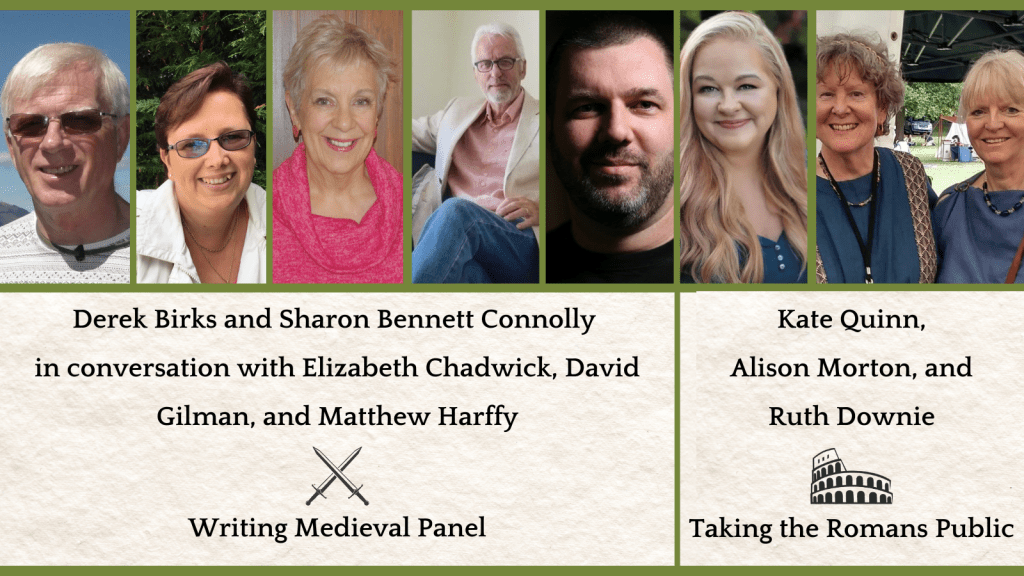
There are panels on writing medieval historical fiction – which I’m very much looking forward to, and on presenting historical fiction on Romans – which I expect will be fun. The conference is packed with useful presentations for both established and aspiring writers. Several presenters have written screenplays or seen their work adapted for tv or film, and several presenters work as professional actors, so I think we will hear lots of interesting behind-the-scenes information. There’s as much here for readers of historical fiction as there is for writers.
What suggestions would you give to someone who is attending a conference for the first time? What about those attending virtually?
Attending a conference for the first time can be daunting, especially if you go alone and don’t know anyone to begin with. But I’ve found the HNS conference goers to be a friendly bunch. I hope the Facebook group for attendees we’ve been running has helped people start to establish connections with both new and old friends.
For virtual attendees, take breaks when you can – have a cup of tea and some fresh air! It gets exhausting being onscreen for long periods of time. If you are in a different timezone, remember that you will get a recording link to watch later. Having said that I did watch most of HNSNA a few years back in the wee small hours wearing my pyjamas and nursing a cup of tea. It’s good to feel part of the live event.
What kinds of “Tips and Tricks” would you offer someone for attending a writing conference? Such as – Getting the most out of the conference? What is one item that they shouldn’t forget to pack? Do people generally bring anything to exchange (cards, pins, etc)? September in Dartington, UK – any clothing recommendations? Anything local that you’d recommend?
Bring business cards and flyers or postcards for your books. Follow up after the conference on the business cards/contacts you have made and the notes on inspirations you have jotted down.
September in Dartington – I’m hoping for sun, but the season is turning towards autumn – I hope we aren’t rained on, but Devon is very green for a reason …
Clothing recommendation – good walking shoes, a light rain jacket, something a little glamorous for the gala dinner… The Cott and Rumour are my favourite places to eat. The coast is fabulous if you have a car to get there. You can swim in the Dart river. Totnes Castle is worth of visit. Brixham is a delightful coastal town.
What is included with the virtual ticket versus being there in person? Are the sessions being recorded?
The virtual ticket covers all sessions in the Great Hall (but not the whole conference). It’s not interactive or hybrid. It is simply a window in – to watch the main sessions. The recordings are only available for virtual registrants.
Are there any other ways to follow the conference? What can you tell me about the roving podcast?
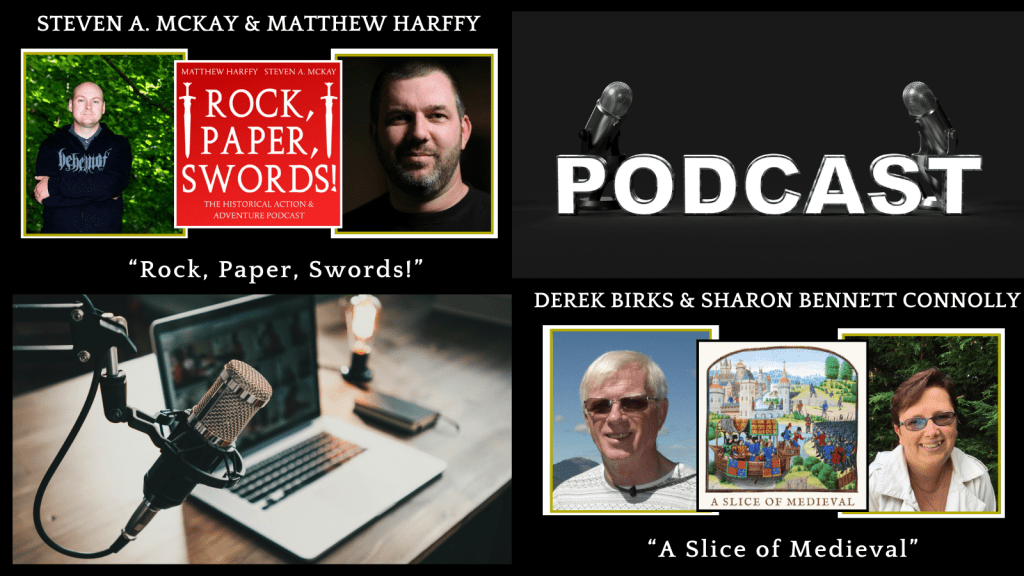
We will post from the conference on social media as it happens. Rock, Paper, Swords!, the roving podcast, (with Matthew Harffy and Steven A. McKay) will be interviewing speakers and conference goers. The Writing Medieval panel is being presented by podcasters, A Slice of Medieval (with Derek Birks and Sharon Bennett Connolly).
Anything that I haven’t hit on that you’d like to highlight?
Dartington is a medieval estate that appears in the Domesday Book. It has a fascinating medieval and modernist history. It’s challenging to get around in a rural area, on a site that is not a custom-built convention centre, but I hope the history of the place will make all that worthwhile.
What advice would you give someone who would be interested in helping to coordinate a conference? Are there ways to be involved that aren’t as intense? Ways to volunteer?
Coordinating the conference is intense. It has taken up a huge amount of my time over the last two years. We began as soon as Durham had finished. So first advice to the next conference organiser – don’t underestimate the time and start early. I’d advise future organisers that the Historical Novel Society North America/HNSNA model could be one to follow. A board of people with designated roles and particular skills – especially managing technology, administration, finance, marketing.
People have also offered help at the conference itself – chairing sessions, picking up speakers at the station, helping with registration, stewarding, running round with the mic in Q & A’s, helping delegates find their way around – that’s all invaluable.
How have you balanced working on the conference with your own writing?
Stubbornness! I decided to publish my new novel a few days before the conference – Love’s Knife, published on 2 September. I’ve had to work to keep both conference and book in tandem and keep both on schedule.
HNS launched the First Chapters Competition with the conference and recruited judges for all three rounds – bravo! We are really excited to hear the announcement at the gala of the overall winner for the competition! In your opinion, what do you think makes a great opening? Do you have any tips for how you write / choose your own? Do we know when the next one will be?
I set up the competition and enlisted the judges – thank you all, but the heavy-lifting of admin for the competition has been done by you, Rebekah – thank you!
A great opening sentence is usually succinct, intriguing, unexpected. I’ve run workshops on openings, middles and endings. Here are some of the openings I focus on:
- It is a truth universally acknowledged, that a single man in possession of a good fortune, must be in want of a wife. (Jane Austen, Pride and Prejudice, 1813)
- It was the afternoon of my eighty-first birthday, and I was in bed with my catamite when Ali announced that the archbishop had come to see me. (Anthony Burgess, Earthly Powers, 1980)
- The snow in the mountains was melting and Bunny had been dead for several weeks before we came to understand the gravity of our situation. (Donna Tartt, The Secret History, 1992)

A great opening chapter needs to introduce us to the protagonist, their dilemma, the setting. The reader has to immediately care about the protagonist and the quest they are about to set off on, the jeopardy they are in. They need to be swiftly led into the world of the novel.
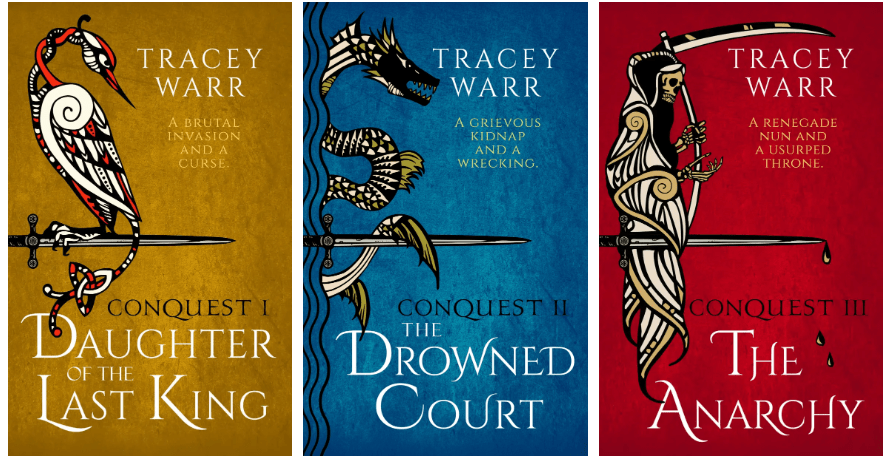
I seem to often be inspired by a kidnap. All the female protagonists in my early novels are kidnapped, ripped from their previous lives and find themselves in a new context.
Tip – look at great openings in other novels.
The competition has been very popular – with other 400 entries from around the world. We don’t know yet when the next iteration will be – depends on volunteers to come forward and organise. A sponsor for the prizes would be good too.
Looking back on your own writing career, what would you say was the most influential writing advice you received from another author? How have you made that work for you?
I think one of the best pieces of advice is ‘ignore advice’. I’ve ignored the adages – ‘write what you know’ and ‘don’t give up the day job’. I like to write what I don’t know. I enjoy the research and finding out new things. But I guess every writer is also drawing on what they know in terms of their own emotional experience, journeys, interactions with other people. I’ve given up the day job on several occasions, when I could, to give my writing a boost – a couple of months off here and there to finish a manuscript, time to undertake a part-time MA in creative writing. It’s important to take yourself seriously as a writer.
However, great advice I’ve used has included David Kaplan’s ‘Laundry List’ of things to excise when revising (Rewriting) and Peter Turchi’s brilliant book on writers using maps: Maps of the Imagination: The Writer as Cartographer.
As a historical writer, if you could stand witness to a historical event or walk through a specific time / scene / building or have a frank discussion with one historical figure, which would you choose and why?
I’d like to sit next to King Henry I of England or Duke Guillaume IX of Aquitaine at dinner in a medieval Great Hall. They both feature as characters in my novels and I had fun creating them. It would be interesting (perhaps mortifying) to discover whether they were anything like how I have imagined them.
What three books do you feel are necessary for any book collection to feel complete? What additional one would you add for an author’s library?
- James Joyce’s Ulysses
- An anthology of Elizabethan poetry, including Shakespeare’s sonnets, John Donne, Thomas Wyatt
- Oxford English Dictionary
- An additional ONE! Only one. Well, Jane Austen’s Pride and Prejudice.
What can you share about what you are writing now? Or an upcoming release?
Love’s Knife, out on 2 September, is a new direction for me. It’s a medieval murder mystery and intended to be the first in a series, featuring a sleuth who is a trobairitz (a female troubadour) and set in southern France and northern Spain at the turn of the 12th century. The trobairitz, Beatriz, solves murders in collaboration with her deaf friend, Anna and her patron, Lady Philippa of Toulouse.

Tracey Warr’s latest novel, Love’s Knife (Trobairitz Sleuth), releases today, September 2, 2024
1093. The music of murder.
Beatriz de Farrera is a trobairitz (a female troubadour) at the court of Toulouse. She sings of love but intends to evade marriage and romantic entanglements. Her patron, Philippa, is the heiress of the rich city and county of Toulouse.
Philippa’s uncle Raimon plans to marry his niece to the ageing king of Aragon, sweep her out of his way and usurp her rights. In a world of scheming lords and plotting abbots seeking to control the riches of local salt production and the pilgrim routes, a brutal murder occurs.
Beatriz finds she has skills other than poetry and music. She must uncover the secrets lurking beneath the glittering surface of the Toulouse court to expose the murderer and avert a great injustice.
What was the last great book that you read?
The Dark Queens, Shelley Puhak’s biography of the 6th-century queens, Fredegund and Brunhild, who were mortal enemies. I’m also really enjoying Sarah Smith’s historical novel about a deaf woman accused of infanticide in Scotland, Hear No Evil, at the moment.
Online tickets for the conference are available:
https://historicalnovelsocietyuk.regfox.com/online
Rebekah Simmers is a member of the HNS UK 2024 conference organisation team. Find out about her novel, The King’s Sword, on her website.

 The Historical Novel Society UK 2024 conference
Leave a reply to Historical Novel Society 2024 UK Conference: Conference Interviews – Rebekah Simmers Cancel reply