
Rebekah Simmers has been interviewing writers who are presenting at the HNS 2024 UK Conference


RS: We are so thrilled that you will be joining us for the HNS 2024 UK Conference! What are you looking forward to about the conference? Can you share a teaser for your presentation?
RD: I haven’t been to the conference in a while, so I’m very much looking forward to catching up with friends and meeting new people. I’m doing a joint presentation with Kate Quinn and Alison Morton – ‘Taking the Romans Public’. We’re hoping to entertain people with things to see as well as voices to listen to, although Alison is slightly worried about getting a sword through airport security…
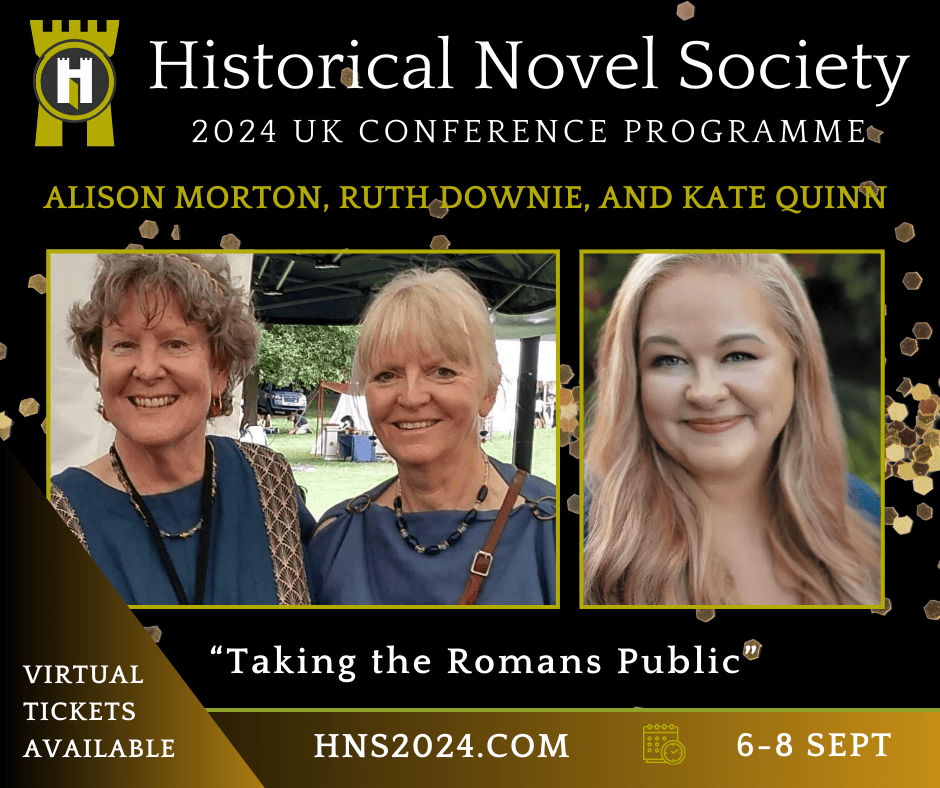
Ruth Downie is presenting “Taking the Romans Public”, with Alison Morton and Kate Quinn at the HNS 2024 UK Conference
Of the wide cast of characters in your novels, who has been your most surprisingly challenging character to write? Why? What strategies did you / do you use for these types of characters?
The emperor Hadrian was a real challenge. I had to include him because he visited Britain during the time the novels take place, and it would have been odd to ignore him. But what is there left to say that hasn’t already been said, and said by people far better qualified than me?
I was rescued by the discovery that he brought his wife Sabina with him. Apparently they loathed each other, and during the trip several of his retinue were sent home in disgrace for behaving towards her “with greater familiarity than the etiquette of the court required”. Goodness knows what that actually meant, but it was fun to invent the missing details of the story.
What do you think it takes to have longevity across a writing career? Sanity? Fun? What’s an unexpected joy that came into your life from such a successful career?
Being honest – writing more than one novel has been the result of editorial pressure. Whilst I enjoy writing and love doing the research, I’ve come to realise that I’m utterly hopeless at finishing anything without a deadline.
The unexpected delight of being published is hearing from people who’ve enjoyed reading the books. It’s an especial honour to know that some people have found spending time with Ruso and Tilla (my lead characters) has been a good distraction during tough times.

Where do you typically begin your research? Do you have a go-to resource? Has there been anything that you’ve researched for your writing over the years that made a huge impact on you or a novel or series that you were writing? That changed how you write or what you write?
I always start with the archaeology – that’s my passion, and I think it helps to avoid cliché if you give the story a firm and specific location. Archaeology also helps to remind us that Roman Britain wasn’t just full of generals and soldiers but ordinary people growing crops and eating dinner. We know because we find the pots they cooked in and the butchered bones of their sheep and cattle.
Of course the down-side of this is that when archaeologists dig up something that changes all their previous ideas, you can come unstuck. So far I’ve pretty much got away with it – and on rare occasions it can work the other way. I once wrote in a flight of steps outside Chester amphitheatre that I realised (too late) weren’t there at all. I doubt anyone else cared or even noticed, but I was very happy when a new dig took place there and they discovered my imaginary steps were real after all!
How do you organize your story details across your series?
I have a spreadsheet somewhere but I generally forget to consult it. Years ago my agent made the wise suggestion that I put a list of characters at the beginning of each book, because there are quite a few of them and they have names from the Roman period. This turns out to be handy not only for readers to remember who’s who, but for me too.
Is there a specific scene that you’ve written over the years that you feel especially connected to? If not a specific scene, a secondary story line that was a favorite to write?
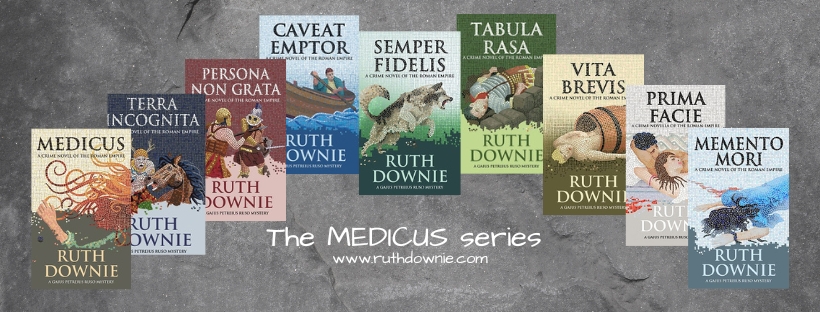
Yes – it’s the chase scene in ‘Persona non Grata’. My hero, hampered by a foot injury, struggles to pursue someone around the maze of staircases and corridors underneath the amphitheatre in Nimes. Lots of people write about what goes on in the arena, but when I saw what was hidden away underneath the banks of seats, I knew my Roman France novel was going to have to have gladiators just so I could make people run around down there.
As a historical writer, if you could stand witness to a historical event or walk through a specific time / scene / building or have a frank discussion with one historical figure, which would you choose and why?
I’d want to ask Hadrian’s wife, Sabina, what really went wrong during their trip to Britannia.
What can you share about what you are writing now? Or an upcoming release?
I’m taking a break at the moment and pondering the future…
What was the last great book that you read?
The Trouble with Goats and Sheep by Joanna Cannon. It’s set in the long hot summer of 1976 and is an entertaining and perceptive portrayal of a small community in a crisis.
Online tickets for the conference are available:
https://historicalnovelsocietyuk.regfox.com/online
Rebekah Simmers is a member of the HNS UK 2024 conference organisation team. Find out about her novel, The King’s Sword, on her website.
 The Historical Novel Society UK 2024 conference
Leave a reply to Historical Novel Society 2024 UK Conference: Conference Interviews – Rebekah Simmers Cancel reply