Rebekah Simmers has been interviewing writers who are presenting at the HNS 2024 UK Conference
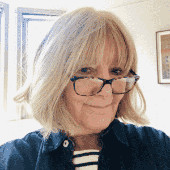
Lisa Highton, who joined Jenny Brown Associates as an Associate Agent in 2022 after a history in publishing, offers insight into writing, publishing, and the journey in between.
Lisa is interviewing S. G. MacLean at the HNS 2024 UK Conference
RS: We are so thrilled that you will be joining us for the HNS 2024 UK Conference! What are you looking forward to about the conference? Can you share a teaser for your presentation?
I’ll be in conversation with Shona MacLean, my client – I was a fan before so I am utterly delighted to be working with her. I’m looking forward to talking to her about her dozen books, her love of history and her writing career, past present and future. She in turn is hoping to turn the tables on me. We’ll see!
As an agent and as one of our Final Round judges for the HNS First Chapters Competition – thank you! – I’d love your opinion on what makes the opening of a novel special. What tends to grab you when you’re reading those first pages? What is one of your favorite openings to a novel that either you’ve simply read or one you’re represented?
I really enjoyed being a judge for the First Chapters Competition – such a talented final round. Thanks for asking me.
Choices, choices for that first line … one of my favourites is ‘Once the queen’s head is severed, he walks away.’ The Mirror and the Light Hilary Mantel, frankly I could have pretty much chosen anything of hers at random. I looked at each of the opening lines from the trilogy and they are all short sharp and intriguing. Her intelligence and command of her subject are second to none – her death was an enormous loss but she left so much behind as rich consolation.
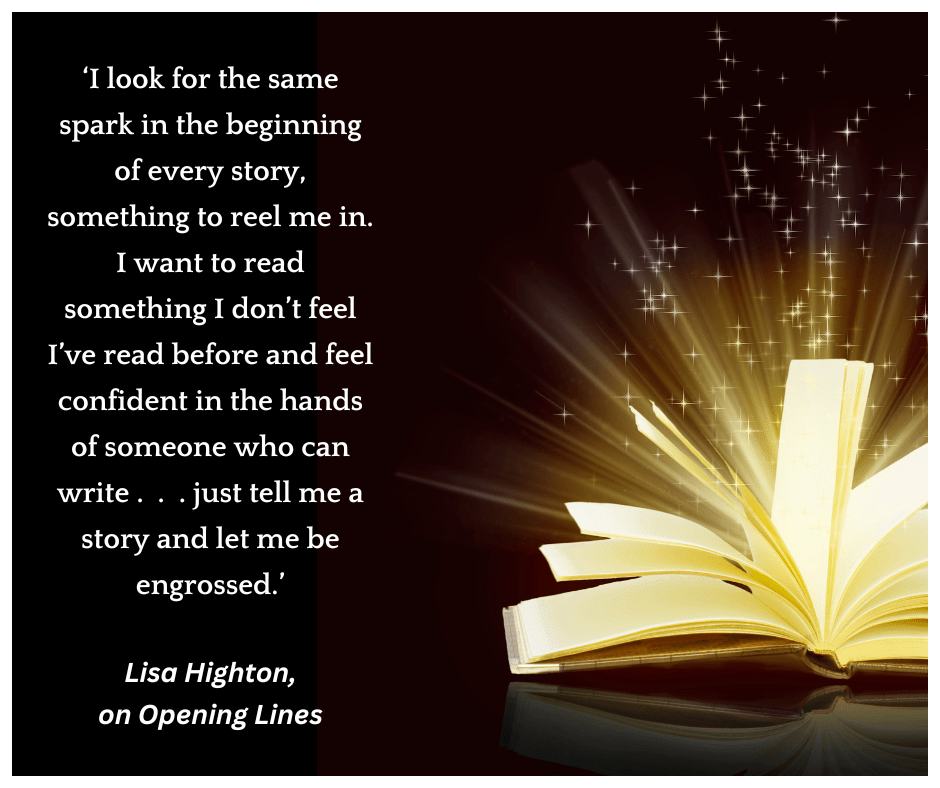
Of course talent such as Hilary Mantel’s is rare but I look for the same spark in the beginning of every story, something to reel me in. I want to read something I don’t feel I’ve read before and feel confident in the hands of someone who can write. It was the same in my former life as a publisher, agents are just at an earlier stage in the life cycle, just tell me a story and let me be engrossed.
What makes you want to read more? What moves a submission into your request pile?
The above really. Plus can I see a market for this?
Could you give us a behind the scenes look at your daily life as an agent? What do you wish writers better understood about your job?
A lot of emailing, sometimes I feel I’m in a losing battle with my inbox! Every day is different but variously I am preparing submissions, chasing submissions, re-chasing submissions, reading new drafts, reading newer drafts, attending events, festivals, book fairs, catching up with editors, reviewing contracts, being in touch with clients regularly, keeping up with news and industry changes, some faffing about essential too.
I think my clients do understand that there’s a great deal of effort that goes into trying to sell a book, and there are no guarantees. A book might be the best thing ever but it’s about finding that one person and timing. Timing is everything.
What’s an unexpected joy that came into your life from such a successful career?
Two things. The joy of helping make a success for the author and their work – nothing like it – and the measure of that success is individual. And deep and abiding friendships. I’ve changed companies, positions, countries and roles but the best relationships in the business morph into something else. This world is wonderful – generous, creative and sustaining.

What would you say are the current and best advantages of working with an agent?
As a publisher I always advised authors to get an agent. And now I am one. It’s a crucial and long-lasting relationship as editors, publishers, companies may change but ideally one’s agent is the constant. They are the balance in a relationship between author and publisher, protecting the author’s rights and career and indeed available for those more difficult conversations. But no agent-publisher-author relationship should be adversarial, we are on the same team and all adults, we all want the books to work and everyone to feel valued and respected. It’s important to let authors have the time and peace of mind to actually create. Having been on both sides I do have an informed all round view and love the detail of a contract or a marketing plan or thinking up ways to help promote and make connections.
How fleshed out do you expect a project to be when contacted by a writer? Is a series pitch too much for a pitch? Or do you prefer standalone projects?
As I’m primarily representing fiction, the ultimate submission will need to be the whole thing and after a lot of work (even before an acquiring editor handles it) look like a real book. On submission the editor has to quickly share with colleagues so it has to be to a professional standard. My job is to work with the author to get it submission-ready.
All that said, I often handle books at an earlier more fragile stage. For instance when we held our Debut Novel Prize for unpublished writers over 50 last year, we initially asked for the first 5000 words and a synopsis of the whole and it is possible to make a judgment call on that basis, at least to see more. If a manuscript isn’t perfect but has some great writing, I can work with that as there’s demonstrable talent even if the word furniture needs moving about, more so than a well presented perfectly competent novel, which I’d struggle to know where to place.
As for series, if there is a strong continuing character and there’s enough to sustain more stories then yes, but it will ultimately be a publisher’s decision, so I would suggest not to write all six volumes and then look for a home, these decisions are market led.
Which do you read first – the query or the pages? Query letters – there’s a lot of advice online about crafting them and what to include. Is there anything that you specifically like to see from authors when they are submitting to you? Do you like a bit of personality to shine through or would you advise authors to keep things formal? Is it more important for you to feel connected to the author or to the project in order to say yes to someone?
I always read the query letter first, though that’s my personal preference – there’s no right or wrong – as I like to get a sense of the writer and where they see their place in the writing world, why they write and why they wrote this. I know the query letter takes more effort than the book for some but bear in mind publishing is a business of opinions but it is a business.
While most letters are usually perfectly straightforward and acceptable I will not proceed with form letters, or those who have clearly not checked our website or what I’m actually looking for (or immediately compare their writing to the Greats).
If I’m interested enough I will be in touch to find out more and start the conversation. If there’s talent there’s an agent for everyone, we’re all different.
What are deal breakers for you when reviewing a potential new author or new manuscript? Do you consider a potential new author if they’ve previously been self-published or is that considered a negative? Do you think it’s a positive if a potential new author already has a social media following? And on the flip side – is it a dealbreaker if they don’t have a large social media following?
Can I work with them? Do I love their writing and can I see how to place their book? Yes, yes could be and no to the other questions. There’s too much emphasis or concern about social media, if one element of it comes naturally to a writer then brilliant but don’t panic, it’s about quality not quantity.
The important thing is the conversion factor of followers to purchasers, the maths don’t always work. There are other ways to reach out to a book’s readers, from events to independent bookshops to festivals and other initiatives. Only connect. Be real.
Tell me about your dream submission. What kinds of stories are you most excited to see in your inbox? Are there specific stories or a historical character you’d love to see come across your desk? Are you currently open to submissions?
I love historical fiction and historical crime, single or twin timelines, women’s stories, ‘why didn’t more people know about her’ discoveries, hidden lives of ordinary people. Though I tend to skew towards the last 250 years (and Tudors and Stuart eras) I am open to being swayed by other periods but I’d be excited if any of the below came across my desk when I’m next open to submission: women artists of the 20th century – Newlyn, Slade school. A female lead for an historical crime series – it can be done. The Cold War, any of those pinch points in history, the mid 60s to 70s are historical now enough time has elapsed.

But as I said, a good book can surprise me and open up whole new worlds – I love that.
What three books do you feel are necessary for any book collection to feel complete? What additional one would you add for an author’s library?
Ah, the favourite child question. My answer will be different whenever you ask me but these reflect the four countries I’ve worked in and with in my professional and personal life:
- UK
- Jane Eyre by Charlotte Bronte
- Australia
- Cloudstreet by Tim Winton
- US
- Crossing to Safety by Wallace Stegner
- Scotland
- O Caledonia by Elspeth Barker
What was the last great book that you read?
Aside from Demon Copperhead?
On my September holiday reading pile is The Glass Maker by Tracy Chevalier, Small Bomb at Dimperley by Lissa Evans and Winter in Madrid by C J Sansom
Lisa Highton joined Jenny Brown Associates as an Associate Agent in 2022 and represents S G MacLean. In 2023 the agency held its inaugural Debut Novel Over 50 Award with over 1700 entries. Until 2021, Lisa was Publisher of Two Roads, an imprint of John Murray Press/Hachette where she published authors including Kirsty Wark, Sally Magnusson, Monty Don, Ruth Hogan and Janet Ellis. Over a long career in publishing both in the UK and Australia where she was publishing director of Doubleday, HarperCollins and then Hodder, Lisa has published many bestsellers. Her passions are distinctive storytelling (often historical) finding those hidden stories with emotional heart and then connecting those stories with readers.
Online tickets for the conference are available:
https://historicalnovelsocietyuk.regfox.com/online
Rebekah Simmers is a member of the HNS UK 2024 conference organisation team. Find out about her novel, The King’s Sword, on her website.
 The Historical Novel Society UK 2024 conference
Leave a reply to Historical Novel Society 2024 UK Conference: Conference Interviews – Rebekah Simmers Cancel reply